
The Ultimate Rifle Buying Guide for Beginners & Hunters
Everything you need to know, action types, calibers, stocks, scopes, storage & legal tips, before spending a single dollar.
Last Updated: 2026
Table of Contents
- Why Buying Wrong Is Easy
- Action Types Explained
- Choosing the Right Caliber
- Hunting Rifle Selection
- Wood vs Synthetic Stocks
- How to Choose a Scope
- Legal Considerations 2026
- Safe Home Storage
- Budget Allocation Guide
- Best Beginner Rifles
- 8 Mistakes to Avoid
- FAQ
Buying your first rifle, or upgrading to a better one, can feel overwhelming. The market in 2026 is flooded with options across every action type, caliber, price point, and use case. Whether you’re a first-time buyer hunting whitetail deer in Georgia, a competitive shooter chasing sub-MOA groups at 500 yards, or a homeowner looking for a reliable semi-auto rifle, this guide has you covered.
This comprehensive rifle buying guide from Golden Brothers Co breaks down every major decision you’ll face before spending a single dollar. For each topic, we’ve linked to dedicated deep-dive guides so you can explore specific subjects in greater detail without getting lost here. Bookmark this page—it is your master reference for choosing the right rifle in 2026.
01 Why Buying the Wrong Rifle Is So Easy
Most beginners walk into a gun store (or land on an online retailer) and make their decision based on looks, brand name, or whatever the salesperson pushes. That’s how you end up with a .308 bolt-action when you wanted a hog-hunting semi-auto, or a budget AR-15 with a wobbly trigger when a Ruger 10/22 would have served you far better for the first year.
The rifle market in 2026 covers:
- Action types: Bolt-action, semi-automatic, lever-action, pump-action
- Calibers: From .22 LR rimfire all the way to .338 Lapua Magnum
- Use cases: Deer hunting, hog hunting, turkey hunting, target shooting, long-range precision, home defense
- Price ranges: $200 budget plinkers to $3,000+ precision rigs
- Legal considerations: Background checks, online purchases, state laws
This guide gives you a structured framework so every decision you make is intentional, not accidental.
02 Understanding Rifle Action Types
The “action” is the mechanism that loads, fires, and ejects cartridges. Choosing the wrong action type for your purpose is one of the most common and costly beginner mistakes.
Bolt-Action Rifles
Bolt-actions require you to manually cycle the bolt between shots. They are the most accurate, most reliable, and most widely recommended for hunting, especially at longer ranges. A bolt-action’s locked-up chamber creates consistent headspace, which directly translates to tighter shot groups.
For budget hunters, bolt-actions under $700 deliver exceptional precision. Models like the Ruger American and Mossberg MVP have changed what “entry-level” means. Best Bolt Action Rifles Under $700 in 2026.
Our top picks for budget bolt-actions that don’t sacrifice accuracy. Includes the Ruger American, Mossberg Patriot, Savage Axis II, and more, with range results. Mossberg MVP vs Ruger American: Which Wins?
Two of the most popular budget bolt-actions go head-to-head. We compare accuracy, triggers, ergonomics, and value for money. Bergara B-14 Review 2026: Precision Hunting Rifle
Is the Bergara B-14 worth the premium? We put it through 500-yard accuracy tests, review its BPAS trigger, and compare it to competitors in its price class.
Semi-Automatic Rifles
Semi-autos fire one round per trigger pull and automatically chamber the next round. They’re ideal for hog hunting (multiple follow-up shots), target sports, and home defense. The AR-15 platform dominates this category, with hundreds of configurations available in 2026.
Semi-autos get a bad rap for complexity, but modern platforms like the AR-15 and Ruger 10/22 are surprisingly beginner-friendly.
A full breakdown of the AR-15 platform for new shooters, best entry-level models, what to avoid, and how to pick your first AR without getting overwhelmed.
You don’t need to spend $2,000 for a reliable semi-auto. These picks deliver performance, reliability, and value, from ARs to pistol-caliber carbines.
The Ruger 10/22 has been the #1 recommended first rifle for 50+ years. Is it still the best choice for beginners in 2026? Our full review with mods guide included.
Lever-Action Rifles
Lever-actions have a rich American heritage and remain highly practical, especially in states with magazine-capacity restrictions, or for hunters who want fast follow-up shots in a package that’s legal virtually everywhere.
From Marlin to Henry to Winchester, a complete guide to lever-actions, their history, best modern models, and why they’re still a great choice in 2026.
03 Choosing the Right Caliber
Caliber selection is the most consequential decision you’ll make. Pick the wrong caliber and you’ll either under-perform on game, overpay for ammo, or punish yourself with unnecessary recoil. Here’s how to think about it:
| Caliber | Best For | Effective Range | Recoil | Ammo Cost |
|---|---|---|---|---|
| .22 LR | Beginners, small game, practice | 75–150 yds | None | Very Low |
| .223 / 5.56 NATO | Varmints, hogs, target | 300–500 yds | Light | Low–Medium |
| .308 Winchester | Deer, elk, long-range | 600–800 yds | Moderate | Medium |
| 6.5 Creedmoor | Long-range hunting & competition | 800–1200 yds | Low–Moderate | Medium |
| .30-06 Springfield | All North American big game | 500–700 yds | Moderate–High | Medium |
| .300 Win Mag | Elk, moose, extreme range | 1000+ yds | High | High |
The .223 vs 5.56 NATO Question
This is one of the most commonly misunderstood topics in the rifle world. Many shooters assume they’re identical and use them interchangeably, this can be dangerous. .223 vs 5.56 NATO: Are They the Same?
We break down the technical differences in chamber dimensions, pressure ratings, and when it matters. Plus: which rifles can safely shoot both, and which cannot.
6.5 Creedmoor vs .308 for Hunters
The 6.5 Creedmoor has largely displaced the .308 in the precision rifle community due to its superior ballistic coefficient and flatter trajectory. But the .308 still has serious advantages for hunters, particularly in penetration on larger animals and ammo availability. 6.5 Creedmoor vs .308: Which Is Better for Hunting?
A data-driven comparison covering ballistics tables, energy at distance, terminal performance on whitetail and elk, and which caliber makes sense for your specific use case.
Long-Range Shooting Calibers
If your goal is shooting past 600 yards, whether for competition or hunting, caliber selection becomes even more critical. Wind drift, bullet drop, and terminal energy all compound dramatically at distance. Best Caliber for Long Range Shooting 2026
From 6.5 Creedmoor to .300 PRC to .338 Lapua, a ranked guide to the best long-range calibers in 2026 with ballistic data, recoil comparison, and ammo cost analysis.
Rimfire vs Centerfire, What New Shooters Must Know
Before picking any caliber, beginners must understand the fundamental difference between rimfire (like .22 LR) and centerfire (like .308) ammunition. This affects everything from reloading capability to rifle action type. Rimfire vs Centerfire: What’s the Difference?
A beginner-friendly breakdown of ignition systems, why rimfire is cheaper and centerfire is reloadable, and which is right for your first rifle purchase.
04 Choosing a Rifle for Hunting
Hunting rifles have specific requirements that target or plinking rifles don’t. Weight matters when you’re hiking miles through dense woods. Reliability matters when you’re in cold, wet conditions. Caliber legality matters in your specific state.
Whitetail Deer Hunting
Whitetail is the most popular big game animal in North America. The “best” deer rifle depends heavily on your terrain, open fields (longer shots) vs dense Southern woods (sub-100-yard shots). Best Hunting Rifles for Whitetail Deer 2026.
Our top-ranked deer rifles across bolt-action, semi-auto, and lever-action categories, with caliber recommendations for different terrain types and budgets.
Hunting in Georgia, Beginner’s Perspective
Georgia hunters deal with specific terrain (swamps, pine forests, open agricultural fields), specific regulations (caliber minimums for deer), and a long season that spans both bow and firearm portions. If you’re new to hunting in the Peach State, this section is for you. Best Hunting Rifles for Georgia Beginners.
Georgia-specific rifle recommendations covering legal calibers, terrain considerations, budget-friendly options, and top picks for beginners hunting the Georgia woods. Best Turkey Hunting Guns in Georgia 2026.
Turkey hunting in Georgia requires specific gear, from shotgun patterns to rifle choices where legal. Our full guide covers Georgia-specific regulations and our top 2026 picks.
Hog Hunting, South Georgia & Beyond
Feral hogs are a serious agricultural and ecological problem across the South, and they’re one of the most exciting (and ethically sound) types of hunting available year-round with no bag limits in most states. Hog hunting demands a reliable semi-auto or a hard-hitting bolt-action, because hogs are tough animals that often require follow-up shots. Best Rifles for Hog Hunting in South Georgia
Caliber recommendations, platform choices (AR-10 vs bolt-action vs lever-action), and specific rifle picks for hunting wild hogs across South Georgia’s terrain.
05 Wood Stock vs Synthetic Stock: What’s Right for You?
The stock is your interface with the rifle, it affects fit, weight, aesthetics, and durability. The debate between wood and synthetic stocks is one of the oldest in the shooting world.
| Factor | Wood Stock | Synthetic Stock |
|---|---|---|
| Aesthetics | Classic, beautiful grain | Tactical, modern |
| Weight | Heavier (varies by wood type) | Generally lighter |
| Weather Resistance | Can warp in humidity/rain | Excellent, no warping |
| Accuracy Stability | May shift POI in humidity changes | Very consistent |
| Price (entry level) | Often higher | Often lower |
| Customization | Limited (requires finishing) | Vast (chassis systems) |
| Hunting in Rain/Cold | Not ideal | Excellent choice |
Best Wood Stock vs Synthetic Stock Rifles. A detailed comparison covering accuracy implications, weather performance, maintenance requirements, and our top-ranked rifles in both categories for 2026.
06 How to Choose a Rifle Scope
Your scope can make or break your shooting experience. A $600 rifle with a $100 scope will consistently underperform a $400 rifle with a $300 scope. Optics are arguably the most important upgrade you can make to any rifle, and new shooters consistently underspend here.
Key factors to understand when choosing a scope:
- Magnification: 3-9x is the classic hunting range; 4-16x+ for precision/long-range
- Objective Lens Diameter: Larger (50mm+) = more light, but heavier mounts required
- Reticle Type: Duplex (hunting), BDC (hunting/distance estimation), MOA/MRAD (precision shooting)
- Focal Plane: First Focal Plane (FFP) scales with magnification; Second Focal Plane (SFP) does not
- Turret Style: Capped (hunting) vs exposed (tactical/long-range)
Everything a beginner needs to know, magnification ranges, glass quality differences, MOA vs MRAD, and our top scope recommendations at every price point from $100 to $1,000.
Sighting In Your Rifle at the Range
Even the best scope is worthless if it’s not properly zeroed. Sighting in (or “zeroing”) your rifle is a fundamental skill every shooter must master. It’s also where many beginners waste significant ammo through inefficient technique. How to Sight In a Rifle at the Range.
Step-by-step guide to zeroing your rifle efficiently, from bore-sighting to final confirmation. Includes a 3-shot zeroing technique that saves ammo and time.
07 Legal Considerations: Buying a Rifle in 2026
Federal law requires a background check (NICS) for all purchases through licensed dealers (FFLs). Online purchases must be transferred through a local FFL dealer. State laws add additional layers, waiting periods, feature restrictions, registration requirements, that vary dramatically.

Buying an AR-15 Online
Online AR-15 purchases are legal at the federal level but involve a multi-step process that confuses many new buyers. Understanding FFL transfers, Form 4473, and shipping restrictions is essential before you click “Add to Cart.” How to Buy an AR-15 Online Legally in 2026
A step-by-step walkthrough of the legal online AR-15 purchase process, choosing a retailer, finding an FFL, completing Form 4473, and what to expect at pickup.
08 Storing a Rifle Safely at Home
Safe storage is not optional, it’s an ethical responsibility. Improperly stored firearms are the leading cause of unintentional shootings involving children and are frequently stolen in residential burglaries. The good news: proper storage doesn’t have to be expensive or complicated.
Storage Options by Budget
- Trigger Locks ($15–30): Basic deterrent; not theft-proof but prevents unauthorized use
- Quick-Access Pistol Safes ($80–200): Good for a handgun or short-barreled rifle
- Long Gun Cabinets ($150–400): Good for multiple rifles; deters casual theft
- Heavy Steel Gun Safes ($500–3,000+): Best protection against theft and fire
A complete home rifle storage guide covering safe recommendations at every budget, child-proofing strategies, humidity control, and what NOT to do when storing long guns.
09 How to Allocate Your Rifle Budget
A common mistake is spending 100% of your budget on the rifle itself, leaving nothing for optics, ammunition, slings, cases, and range time. Here’s a practical framework:
| Total Budget | Rifle | Optic | Ammo / Mags / Accessories |
|---|---|---|---|
| $500 | $300–350 | $100–130 | Remainder |
| $1,000 | $550–650 | $250–300 | Remainder |
| $1,500 | $800–950 | $400–500 | Remainder |
| $2,000+ | $1,000–1,400 | $600–800 | Remainder |
Notice that we consistently recommend spending roughly 30–40% of your total budget on optics. This is not an exaggeration, glass quality directly determines how well you can shoot the rifle you’ve purchased.
10 Best Beginner Rifles: Our Top Picks for 2026
After reviewing action types, calibers, stocks, and budgets, here are our top recommendations for first-time buyers in 2026, organized by use case: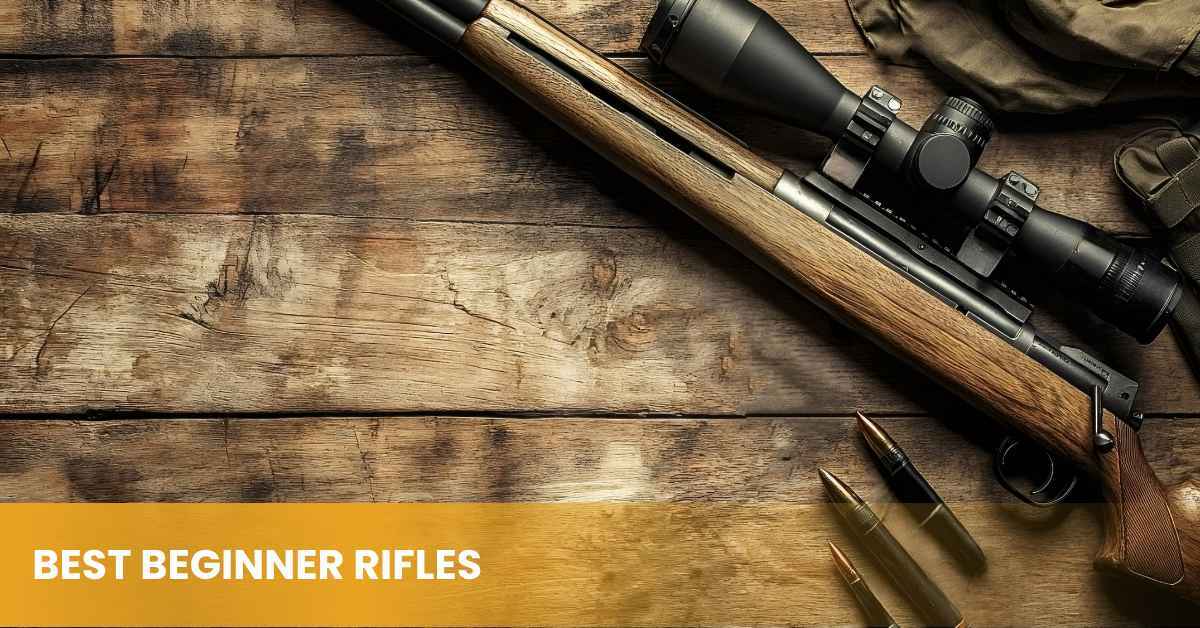
Best First Rifle Overall: Ruger 10/22
The Ruger 10/22 has been the #1 recommended starter rifle since the 1960s. In .22 LR, it offers negligible recoil, extremely cheap ammo, and an enormous aftermarket ecosystem. Beginners learn trigger control, sight alignment, and safe gun handling without flinching from recoil or burning through expensive ammo. Ruger 10/22 Review 2026: Best Beginner Rifle?
Full review covering accuracy testing, aftermarket upgrade path, best factory configurations, and whether the 10/22 is still the best starter rifle in 2026.
Best Budget Bolt-Action: Ruger American / Mossberg MVP
Both rifles punch well above their weight class. The Ruger American offers an outstanding factory trigger for its price. The Mossberg MVP’s ability to use AR-15 magazines (in .223/5.56) adds versatility. Both regularly achieve sub-MOA groups with quality ammunition. Mossberg MVP vs Ruger American: Which Wins?
Detailed head-to-head comparison with accuracy data, trigger pull weights, ergonomics scoring, and a clear winner recommendation based on your use case.
Best Precision Rifle: Bergara B-14
If your budget stretches to $900–1,100, the Bergara B-14 series represents exceptional value in the precision bolt-action market. Its BPAS trigger, hand-lapped barrel, and chassis options deliver sub-half-MOA accuracy that competitors charge significantly more for. Bergara B-14 Review 2026: Precision Hunting Rifle
Our most in-depth precision rifle review of 2026, covering accuracy testing at 100, 300, and 500 yards, comparison to Tikka T3x and Savage 110, and best configurations for hunters.
11 8 Mistakes Every First-Time Rifle Buyer Makes
- Underspending on optics. A $150 scope on a $800 rifle is like putting budget tires on a sports car. The scope limits everything.
- Choosing caliber based on what’s “cool.” A .338 Lapua is not the right whitetail deer rifle. Match caliber to use case.
- Ignoring recoil. Flinching due to excessive recoil destroys accuracy. Start lighter than you think you need.
- Skipping a professional fitting. A rifle that doesn’t fit your length of pull will never shoot well. Try before you buy.
- Buying the rifle without budgeting for ammo. You need to shoot to learn. Budget 200–500 rounds minimum for the first month.
- Neglecting safe storage. Buying a rifle without a safe or lock is irresponsible and dangerous. Budget storage costs in from day one.
- Overcomplicating the first purchase. The Ruger 10/22 or a basic bolt-action in .308 will serve a beginner better than an expensive tricked-out AR.
- Not zeroing before hunting season. Never take a rifle hunting that hasn’t been properly zeroed at your intended range. This is a non-negotiable safety and ethics issue.
12 Frequently Asked Questions
The Ruger 10/22 in .22 LR is the most universally recommended first rifle. Cheap ammo, no recoil, excellent reliability, and massive aftermarket support make it the ideal learning platform. Once you’ve mastered fundamentals, upgrade to a centerfire rifle based on your use case.
$300–600 is the sweet spot for a first rifle. In this range, options like the Ruger American, Savage Axis II, and Ruger 10/22 Takedown offer excellent value. Always reserve at least 25–30% of your total budget for an optic, see our scope buying guide for recommendations at every price point.
It depends on your use case. For long-range shots beyond 500 yards and lighter recoil preference, 6.5 Creedmoor has a real ballistic advantage. For general hunting within 400 yards, .308 offers comparable performance with better ammo availability and typically lower cost per round.
Yes. Online purchases are legal at the federal level but must be transferred through a licensed FFL dealer in your state. You’ll complete a standard background check (Form 4473) at the FFL. See our complete walkthrough: How to Buy an AR-15 Online Legally in 2026.
They are similar but not identical, and using them interchangeably can be dangerous. Our full guide explains the pressure and chamber dimension differences. Short answer: a 5.56 NATO-chambered rifle can safely fire both; a .223-chambered rifle should not fire 5.56 NATO.
Legally, it depends on your state. Ethically and practically, yes, absolutely. If you have children in the home or visitors with children, safe storage is non-negotiable. Even a trigger lock is better than nothing. See our home rifle storage guide for options at every budget starting at $15.
Georgia law requires a minimum of .22 caliber centerfire for deer. In practice, we recommend .243 Winchester minimum, with .308, 6.5 Creedmoor, or .30-06 being ideal. See our Georgia-specific beginner rifle guide for complete caliber and rifle recommendations.