
If you’ve already got an AR-15, or you’re shopping for your first one, you’ve probably run into this exact debate somewhere: 300 Blackout vs 5.56. Two shooters at the range will give you two completely different answers, and both of them will sound convinced they’re right.
The truth is that 300 Blackout vs 5.56 isn’t about finding one caliber that’s universally better. Each was designed for a different purpose, and once you understand those differences, choosing the right one becomes much easier. In this 300 Blackout vs 5.56 guide, we’re breaking the comparison down category by category—ballistics, effective range, accuracy, recoil, home defense, hunting, cost, and ammunition availability, so you can confidently decide which caliber best fits your shooting style.
If you’re completely new to the platform, our 300 Blackout Rifle Guide for Beginners covers everything you need to know about the rifle itself, including barrel lengths, suppressor setups, legal purchasing considerations, and first-time buyer tips before diving into the 300 Blackout vs 5.56 debate. It’s the perfect starting point if you’re beginning from scratch.
By the end of this 300 Blackout vs 5.56 comparison, you’ll understand the strengths and trade-offs of each caliber instead of relying on opinions from the range or internet forums.
If you shoot primarily inside 200 yards, want exceptional suppressor performance, or are concerned about reduced overpenetration for home defense, 300 Blackout is generally the stronger choice. If your priorities are maximum effective range, affordable ammunition, and high-volume range sessions, 5.56 NATO comes out ahead. Ultimately, the 300 Blackout vs 5.56 decision depends on how you actually use your rifle, and many experienced AR-15 owners eventually keep both—using one upper for each specific purpose.
Now let’s get into the details.
1. Ballistics: What’s Actually Happening Downrange
The core difference comes down to bullet weight and velocity.
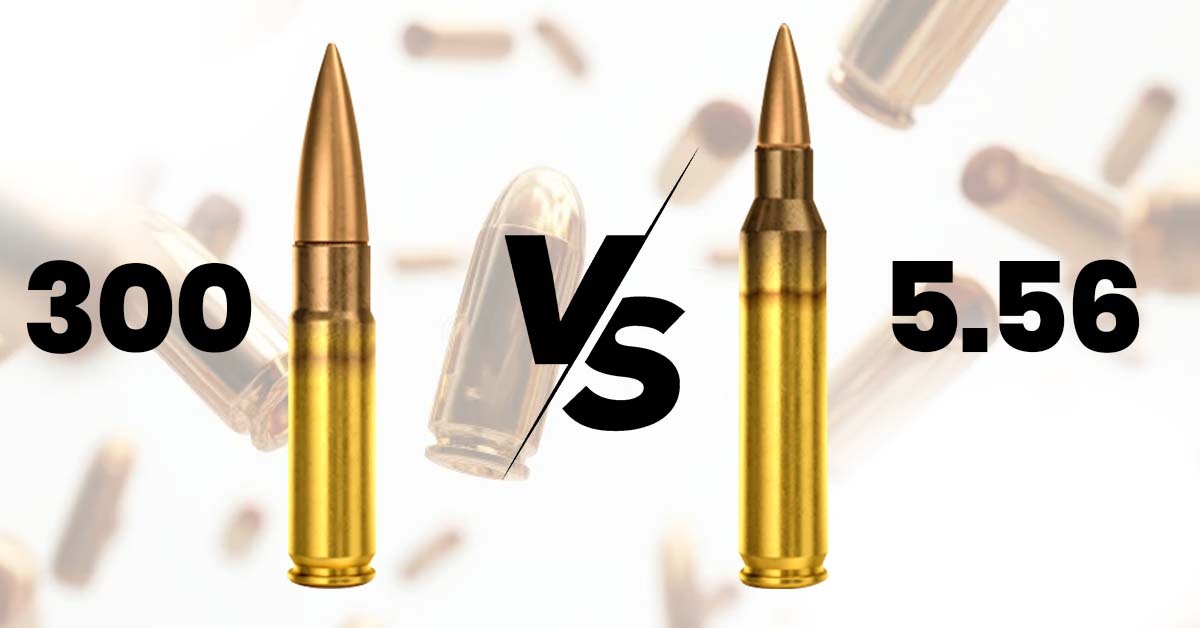
5.56 NATO typically fires a 55-77 grain bullet at 2,900-3,200 feet per second out of a 16-inch barrel. It’s light, fast, and flies flat, which is exactly what it was designed for.
300 Blackout fires a heavier .30 caliber bullet, usually 110-125 grains in supersonic loads, or 190-220 grains in subsonic loads, at roughly 2,000-2,200 fps supersonic, or around 1,000 fps subsonic. It trades velocity for mass and diameter.
What this means in practice: 5.56 relies on speed to do damage, which is why it loses effectiveness fast once velocity drops. 300 Blackout relies more on bullet weight and diameter, so it holds its terminal performance better at the ranges it’s actually built for, inside 200-300 yards.
2. Range: Where Each Caliber Actually Performs
This is the most decisive category, and it’s not close.
5.56 NATO stays effective out to 400-500 yards in the hands of a competent shooter, and it’s flat-shooting enough that holdover isn’t a major concern inside that window.
300 Blackout starts dropping off noticeably past 200 yards, and by 300 yards, the bullet drop is significant enough that you need to actually compensate for it. Past 300 yards, it’s simply not the right tool.
Verdict: If range is your priority, at all, 5.56 wins without argument. 300 Blackout was never designed to compete here, and pretending otherwise does you no favors.
3. Accuracy: Which Groups Tighter?
At their respective intended ranges, both calibers are genuinely accurate. This category is closer than people expect.
Inside 100 yards, a quality 300 Blackout rifle with the right twist rate (1:7 or 1:8) can print groups just as tight as a comparable 5.56 rifle. Some shooters actually find subsonic 300 Blackout slightly more forgiving up close, because there’s less recoil disturbance between shots.
Stretch things out past 200 yards, and 5.56’s flatter trajectory and higher velocity make it noticeably easier to stay accurate without constant holdover adjustments.
Verdict: Close-range accuracy, essentially a tie. Long-range accuracy, 5.56 pulls ahead due to trajectory alone, not inherent precision.
4. Recoil: Which Is Easier to Shoot Fast?
Neither caliber kicks hard, this isn’t a .308 vs 5.56 conversation, but there is a difference.
5.56 NATO has famously light recoil, often described as barely more than a .22LR in a properly weighted AR-15. This is a big reason it became the standard for high-volume training and competition shooting.
300 Blackout supersonic loads have slightly more felt recoil than 5.56, due to the heavier bullet, though it’s still mild by rifle standards. Subsonic 300 Blackout loads, interestingly, often feel like the softest-shooting rifle round you’ll fire, since there’s so little powder involved.
Verdict: 5.56 for high-round-count range days and faster follow-up shots. Subsonic 300 Blackout for the softest-shooting experience overall, if you don’t mind the reduced range.
5. Home Defense: Which One Should Be by Your Bed?
This is where the conversation gets genuinely interesting, because the “obvious” answer isn’t always the right one.
5.56 NATO is fast and often fragments on impact, which some shooters like for reduced overpenetration through interior walls, though this varies significantly by barrel length and bullet type.
300 Blackout, especially subsonic loads, is popular for home defense specifically because the reduced velocity generally means less overpenetration risk compared to high-velocity 5.56, while still delivering solid stopping power at typical indoor engagement distances (under 25 yards). Pair it with a suppressor, and you also protect your hearing in an enclosed space during an actual defensive scenario, something that matters more than most people think about until they’ve heard an unsuppressed rifle fired indoors.
Verdict: Both are legitimate home defense choices. 300 Blackout has a slight edge for indoor-specific scenarios, particularly with subsonic loads and a suppressor, but a well-chosen 5.56 defensive load is also a solid, proven option.
6. Hunting: Which Caliber Brings More Game Home?
5.56 NATO is legal for varmint and predator hunting in most states, but many states restrict or discourage it for deer-sized game due to its lighter bullet weight and questionable ethical terminal performance on larger animals.
300 Blackout, with its heavier .30 caliber bullet, is a genuinely capable deer and hog round inside 150-200 yards, and it’s increasingly popular with hunters specifically because of this. The heavier bullet handles bone and tissue on medium game far more confidently than 5.56 does.
Verdict: 300 Blackout is the clear winner for deer and hog hunting. 5.56 stays in its lane for varmints and predators.
7. Cost: What You’ll Actually Spend
This is where 5.56 pulls firmly ahead, and it’s not a small gap.
5.56 NATO is one of the cheapest centerfire rifle rounds on the market, largely because of massive military and civilian production volume. Bulk range ammo is widely available at a low per-round cost.
300 Blackout costs noticeably more per round, often 1.5 to 2 times the price of comparable 5.56 ammo, because production volume is lower and the cartridge itself uses more material.
Verdict: If you’re training frequently or shooting high volumes at the range, that cost difference adds up fast. 5.56 wins decisively here.
8. Ammo Availability: Can You Actually Find It?
5.56 NATO is available essentially everywhere, gun stores, sporting goods stores, big box retailers, all carry it in multiple loads and price points.
300 Blackout availability has improved dramatically over the past several years as the cartridge has grown in popularity, but it’s still not quite as universally stocked as 5.56, particularly in rural areas or smaller shops.
For a current, reliable selection of both, the rifle ammo section at Golden Brothers Co carries supersonic and subsonic 300 Blackout loads alongside a wide range of 5.56 options, so you’re not stuck hunting around for stock.
Verdict: 5.56 is easier to find on short notice. 300 Blackout requires a bit more planning, but it’s no longer the scarcity issue it was a decade ago.
Side-by-Side Summary
| Category | 300 Blackout | 5.56 NATO |
|---|---|---|
| Effective Range | Up to ~300 yards | Up to ~500 yards |
| Accuracy (close range) | Excellent | Excellent |
| Accuracy (long range) | Drops off past 200-300 yds | Stays flat and consistent |
| Recoil | Mild, softest with subsonic | Very light |
| Home Defense | Strong, especially subsonic | Strong, proven track record |
| Hunting (deer/hog) | Excellent | Not recommended |
| Cost per Round | Higher | Lower |
| Ammo Availability | Improving, still less common | Widely available everywhere |
| Suppressor Performance | Excellent (purpose-built) | Good, not optimal |
So, Which One Actually Wins?
If you’ve already got an AR-15, or you’re shopping for your first one, you’ve probably run into this exact debate somewhere: 300 Blackout vs 5.56. Ask two shooters at the range, and you’ll likely get two completely different answers, with both convinced their choice is the best.
The truth is that 300 Blackout vs 5.56 isn’t about declaring one caliber the overall winner. These cartridges were designed with different purposes in mind, and understanding those differences makes the decision much easier. In this 300 Blackout vs 5.56 comparison, we’ll break everything down category by category—including ballistics, effective range, accuracy, recoil, home defense, hunting, ammunition cost, and ammo availability, so you can confidently choose the caliber that fits your shooting needs.
If you’re new to the platform, our 300 Blackout Rifle Guide for Beginners covers everything you need to know about the rifle itself, including barrel lengths, suppressor setups, legal purchasing considerations, and first-time buyer tips before diving deeper into the 300 Blackout vs 5.56 discussion. It’s the perfect place to start if you’re building your knowledge from the ground up.
Whether you’re buying your first AR-15 or adding another upper to your collection, understanding the real-world differences in 300 Blackout vs 5.56 performance will help you make a smarter long-term investment instead of relying on internet opinions.
If you primarily shoot inside 200 yards, plan to run a suppressor, or want reduced overpenetration for home defense, 300 Blackout is generally the stronger option. On the other hand, if your priorities are longer effective range, inexpensive ammunition, and frequent practice sessions, 5.56 NATO remains hard to beat. Ultimately, the 300 Blackout vs 5.56 decision comes down to how you use your rifle, and many experienced AR-15 owners eventually own both configurations because each excels in different situations.
By the end of this 300 Blackout vs 5.56 guide, you’ll have a clear understanding of the strengths and limitations of each caliber, making it easier to choose the right one for your specific shooting goals.
For official cartridge specifications and industry standards on both rounds, the Sporting Arms and Ammunition Manufacturers’ Institute (SAAMI) maintains the authoritative technical data used across the firearms industry.
Frequently Asked Questions: 300 Blackout vs 5.56
Q: Is 300 Blackout more powerful than 5.56?
More powerful” depends on distance. Inside 200 yards, 300 Blackout’s heavier bullet often delivers more effective terminal performance. Past 300 yards, 5.56’s velocity and trajectory give it the advantage.
Q: Which is better for a first AR-15, 300 Blackout or 5.56?
For most first-time AR-15 owners, 5.56 makes more sense as the primary build, it’s cheaper, more available, and better for learning fundamentals. 300 Blackout is an excellent second upper once you know what you want from it.
Q: Can I shoot both calibers from the same rifle?
Not without swapping the upper receiver (specifically the barrel). The lower receiver and magazines are shared, but 5.56 and 300 Blackout require different barrels and cannot be interchanged in the same barrel.
Q: Is 300 Blackout better for home defense than 5.56?
Both work well. 300 Blackout, particularly subsonic loads, is often preferred for reduced overpenetration risk indoors, but a properly chosen 5.56 defensive load is also a proven, effective option.
Q: Why is 300 Blackout ammo more expensive than 5.56?
Lower production volume and more material per round. As demand has grown, prices have come down somewhat, but 5.56 still benefits from massive scale that keeps it cheaper.
This article is intended for educational purposes. Always comply with all applicable federal, state, and local laws when purchasing or possessing firearms and ammunition.