
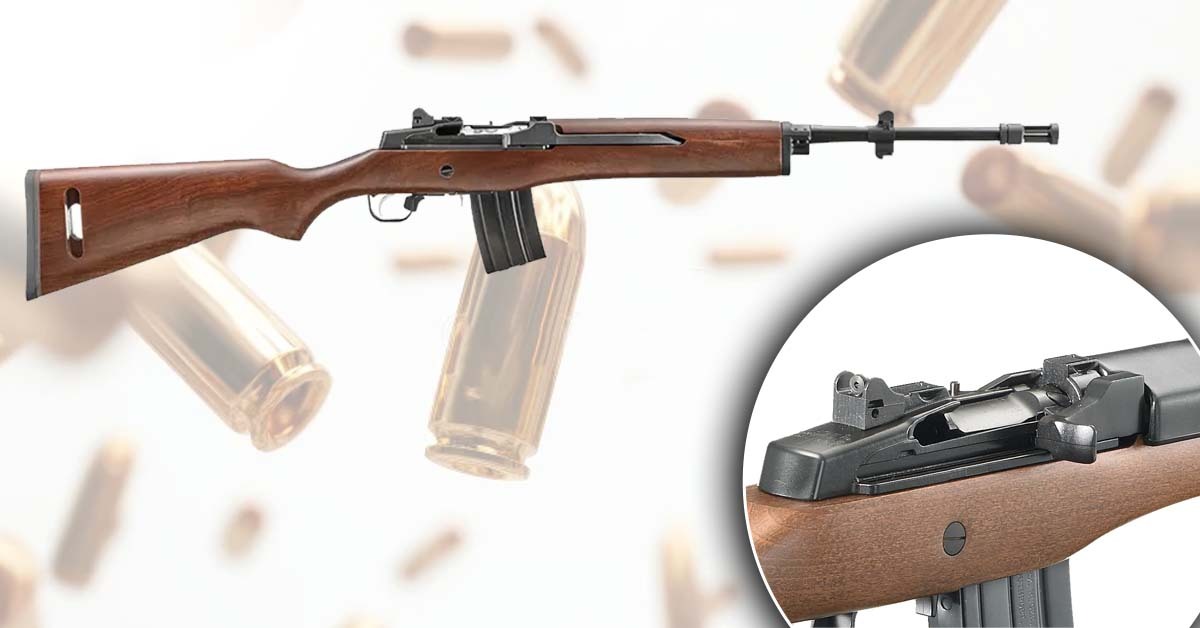
Some rifles earn their reputation through raw specs. Others earn it through decades of showing up in ranch trucks, farm fields, and law enforcement armories and simply not failing. The Ruger Mini-14 is firmly in the second category.
Introduced in 1973 and still in production today, the Mini 14 has quietly accumulated over 3 million units sold without ever trying to be the most tactical, the most modular, or the most talked-about rifle in the room. It just works. But does that still matter in 2026, when the AR-15 platform has become ubiquitous, affordable, and deeply refined? That’s exactly what we’re going to find out.
Where the Mini-14 Came From
The Mini-14 was Ruger’s answer to a specific problem: the military M14 rifle was excellent but too large and heavy for civilian ranch and field use. Bill Ruger scaled the concept down, chambered it in .223 Remington (later 5.56 NATO), and built it around a Garand-style action that American shooters already knew and trusted.
The result was a rifle that felt familiar, handled quickly, and didn’t look like a military weapon which mattered both culturally and legally in many states. Farmers, ranchers, and rural property owners adopted it immediately. Law enforcement agencies in smaller jurisdictions used it as a patrol rifle. And several state-level assault weapon bans that restricted AR-15-style rifles left the Mini-14 untouched due to its traditional stock profile, making it the only practical semi-auto option for many shooters in restricted states.
That history matters because it explains the Mini-14’s continued relevance. It was designed for a specific type of shooter with specific needs and those shooters still exist.
Specs | What You’re Working With
| Spec | Mini-14 Ranch Rifle (Current Production) |
|---|---|
| Action | Semi-automatic, Garand-style |
| Caliber | 5.56 NATO / .223 Remington |
| Barrel Length | 18.5″ |
| Overall Length | 37.5″ |
| Weight | 6.9 lbs (unloaded) |
| Capacity | 5-round (standard), 20-round available |
| Gas System | Fixed-piston, self-cleaning cylinder |
| Stock | American hardwood or synthetic |
| Finish | Blued or stainless steel |
| Sights | Protected blade front, adjustable ghost ring rear |
| Optics | Integral scope bases + included rings |
| MSRP | ~$1,229 – $1,299 |
Handling and Ergonomics, The First Thing You Notice
Pick up a Mini-14 after spending time with an AR-15 and the first thing you notice is how different it feels and not in a bad way.
The traditional wood or synthetic stock sits comfortably against the shoulder without the angular bulk of a carbine stock. At 6.9 pounds unloaded, it balances well and carries naturally. The overall length of 37.5 inches keeps it maneuverable through tight spaces a truck cab, a dense woodline, or a barn door without the barrel feeling stubby or the handling feeling cramped.
The controls are deliberately simple. The safety is located inside the trigger guard and is fully ambidextrous push forward to fire, pull back to safe. It’s fast to operate under stress and doesn’t require changing your grip. The bolt hold-open button sits atop the receiver and is easy to reach. Magazine changes feel different from an AR the Mini-14 uses a tilt-and-rock insertion rather than a straight drop and it takes a few sessions to get smooth with it if you’re coming from an AR background, but it becomes second nature quickly.
What you won’t find here is a free-float handguard, an adjustable stock, or a full-length Picatinny rail from the factory. The Mini-14 is not a modular rifle. That’s intentional, and for the shooter it was designed for, it’s not a limitation it’s a feature. For shooters comparing traditional designs with other modern sporting rifles, the differences become even more apparent.
Accuracy, The Honest Story
This is where the Mini-14’s history gets complicated, and it’s worth being direct about it.
Early-production Mini-14s from the 1970s through the early 2000s had a well-documented accuracy problem. The original thinner barrels heated up quickly and walked their point of impact significantly during sustained fire. Four-inch groups at 100 yards were considered acceptable which, by modern standards, they aren’t.
Ruger addressed this comprehensively in their 580-series production update. They fitted a heavier, tapered barrel, revised the gas system to reduce barrel vibration, and tightened manufacturing tolerances throughout. The results were measurable: current-production Mini-14 Ranch Rifles consistently produce 2-inch groups or better at 100 yards from a supported position with quality ammunition.
That’s not benchrest accuracy, and it’s not AR-15 accuracy with a quality barrel. But it is honest, practical accuracy for everything the Mini-14 was designed to do varmint control, property defense, hunting within 200 yards, and recreational shooting. At 300-400 yards in field conditions, a skilled shooter can still put rounds on target consistently.
The key distinction is this: the Mini-14 is a field rifle, not a precision rifle. If you need sub-MOA performance for competition or long-range work, look elsewhere. If you need a rifle that hits what you aim at across practical ranch and field distances, the current-production Mini-14 delivers. Many shooters exploring different rifle platforms for these applications often compare similar options before making a final choice.
Reliability, Where It Actually Earns Its Reputation
If accuracy is the Mini-14’s complicated story, reliability is its straightforward one.
The fixed-piston gas system borrowed from the Garand is mechanically simpler than the direct impingement system used in most AR-15 variants. There are fewer parts interacting under pressure, and the self-cleaning moving gas cylinder means carbon fouling doesn’t accumulate in the bolt carrier the same way it does in a DI system. Law enforcement agencies that used Mini-14s as patrol rifles reported far fewer stoppages during extended training courses compared to AR-platform rifles that weren’t cleaned on schedule.
The Mini-14 runs dirty. It runs in cold weather. It runs when it’s been stored in a truck for a month and the lube has partially dried out. It is not the rifle you’d choose if you needed to push extreme round counts through a long competition stage but for the intended use case of a ranch, farm, or property rifle that gets used hard, stored in variable conditions, and doesn’t always get the cleaning attention it deserves, the reliability record is genuinely impressive. If you’re interested in exploring additional rifle options for hunting, sport shooting, or property defense, browse our selection of rifles.
Mini-14 vs. AR-15, The Real Comparison
Almost every Mini-14 evaluation eventually comes back to this comparison, so let’s address it directly rather than dance around it.
| Category | Mini-14 Ranch | AR-15 (Mid-tier) |
|---|---|---|
| Price | ~$1,250 | ~$700 – $1,100 |
| Accuracy (100 yd) | ~2 MOA | ~1–2 MOA |
| Modularity | Low | Very High |
| Reliability (dirty) | Excellent | Good |
| Recoil | Mild | Mild |
| Legal in restricted states | Often yes | Often no |
| Appearance | Traditional | Tactical |
| Aftermarket support | Limited | Extensive |
| Magazine compatibility | Mini-14 specific | Mil-spec standard |
The AR-15 wins on price, modularity, aftermarket ecosystem, and if you’re being precise raw accuracy ceiling. The Mini-14 wins on reliability under neglect, legal compliance in restricted states, traditional aesthetics, and the simplicity that comes from a design that doesn’t require decisions about handguard length, buffer weight, or BCG coatings.
Neither platform is objectively better. They’re designed for different shooters with different priorities. The AR-15 is the better choice for someone who wants to build, customize, and optimize. The Mini-14 is the better choice for someone who wants to buy a rifle, put it in the truck, and trust it to be there when they need it.
Who Should Buy the Mini-14 in 2026?
The Mini-14 makes sense for:
- Ranchers and rural property owners who want a practical, reliable 5.56 rifle without tactical aesthetics
- Shooters in California, New York, Maryland, New Jersey, or other states where AR-15-style rifles are restricted
- Hunters targeting varmints and predators within 200 yards who prefer a traditional rifle profile
- First-time centerfire rifle buyers who want simplicity over modularity
- Collectors and shooters who appreciate the Garand-style action and American firearms heritage
The Mini-14 is probably not for you if:
- You want sub-MOA precision for long-range or competition work
- You plan to extensively customize with rails, stocks, and accessories
- Budget is a primary concern the AR-15 platform delivers similar function at lower cost
- You’re already deeply familiar and comfortable with the AR ecosystem
Ammunition and Optics, Getting the Most Out of It
The Mini-14 is chambered for both .223 Remington and 5.56 NATO, and like most 5.56-chambered rifles, it can safely fire both. For best accuracy, quality brass-cased ammunition in the 55–77 grain range tends to perform best in the 18.5″ barrel. Heavier bullets stabilize well in the 1:9 twist rate of current-production rifles.
For optics, the integral scope bases machined directly into the solid steel receiver are one of the Mini-14’s underrated advantages. They eliminate the adapter rail that many rifles require and provide a stable, consistent mounting surface. A low-power variable optic (LPVO) in the 1-4x or 1-6x range is the natural pairing, it extends the rifle’s effective range without making it unwieldy for closer work.
If you’re building a complete ranch rifle setup and looking for quality rifle and scope combinations, Golden Brothers Co. carries a broad inventory of semi-automatic rifles and optics-ready configurations from established manufacturers. As an FFL dealer in operation since 1909, they handle transfers and can help match the right setup to your intended use.
For shooters specifically thinking about ammunition selection, matching your practice load grain weight to your hunting or defensive load, the logic carries over from handguns to rifles. Check out our earlier breakdown on choosing the right ammo for range and field use for the principles that apply across platforms.
Final Verdict, Is the Mini-14 Still Worth It?
Yes, for the right buyer.
The Ruger Mini-14 Ranch Rifle is not trying to compete with the AR-15 on the AR-15’s terms. It offers a different set of strengths: proven gas-piston reliability, a traditional profile that works in restricted states and on working properties, an action that runs in conditions where a less forgiving rifle might not, and more than five decades of manufacturing refinement behind it. According to Ruger’s official Mini-14 specifications, the platform continues to be one of the company’s most enduring rifle designs.
The current-production 580-series and beyond have addressed the accuracy concerns that followed earlier models. Two-MOA performance at 100 yards is real and repeatable. That’s not a precision rifle, but it’s a thoroughly capable one for everything from predator control to property defense. As many experienced shooters and trainers have noted through organizations such as NRA Shooting Sports USA, practical field accuracy is often more important than benchrest-level precision for real-world hunting and ranch applications.
If you’ve been on the fence about the Mini-14, the honest answer is this: it earns its place. Not because it’s the best at any single thing, but because it’s genuinely good at everything its intended users actually ask it to do, consistently, reliably, and without drama. For buyers looking to compare the Mini-14 with other proven rifle platforms, browsing a wider selection of rifles can provide useful context before making a final decision.