
The Complete Handgun Buying Guide (2026)
Everything You Need to Know Before You Buy!
Last Updated: 2026 | Reading Time: ~25 Minutes | Beginner to Advanced
Buying your first, or even your fifth, handgun is not a decision you make on impulse. It is one of the most personal purchases you will ever make. The right handgun protects your family, performs reliably at the range, and fits your hand like it was built for you. The wrong one ends up sitting in a safe, collecting dust.
This guide exists to close the gap between walking into a gun store overwhelmed and walking out confident. We have written it for first-time buyers, returning shooters upgrading from an older pistol, and experienced gun owners who simply want a well-organized reference to share with a friend.
By the time you reach the last chapter, you will understand calibers, action types, frame sizes, budgets, brands, safety practices, and the legal process of buying online. Nothing is dumbed down. Everything is honest.
Let’s get into it.
What This Guide Covers
Chapter 1 — Why Handguns: The Case for a Pistol or Revolver
Chapter 2 — Purpose First: What Do You Need It For?
Chapter 3 — Caliber Guide: 9mm, .45 ACP, .40 S&W, .357 Mag & More
Chapter 4 — Semi-Auto vs Revolver: Honest Pros and Cons
Chapter 5 — Frame Size: Full Size vs Compact vs Subcompact
Chapter 6 — Budget Breakdown: What $300, $500, $800 Buys You
Chapter 7 — Top Handgun Brands in 2026
Chapter 8 — Key Features to Look For
Chapter 9 — How to Buy a Handgun Online: FFL Transfer Explained
Chapter 10 — Handgun Safety: Rules Every Owner Must Follow
Chapter 11 — Your First Range Day: What to Expect
Chapter 12 — FAQs: The 10 Questions We Hear Every Single Week
Chapter 13 — Related Guides: Explore the Full Handgun Cluster
Chapter 1 : Why Handguns: The Case for a Pistol or Revolver
When people think about personal firearms, they often start with the question: why a handgun at all? Why not a shotgun for home defense, or a rifle for range work?
The answer is portability and versatility. A handgun goes where long guns cannot. It fits in a holster on your hip, in a bedside drawer, in a vehicle console, or in a small safe mounted to your nightstand. It is the one firearm that is genuinely usable in most real-world defensive scenarios, where space is tight and speed matters.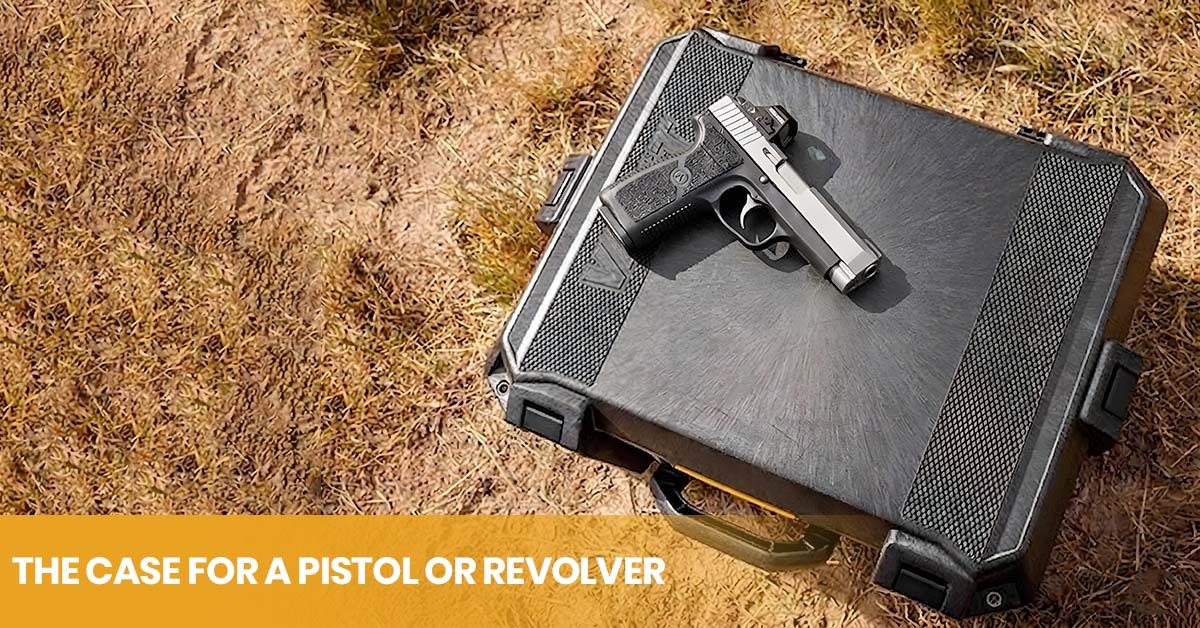
Handguns for Home Defense
Inside a home, a handgun is easier to maneuver through hallways and doorways than a rifle or shotgun. You can hold a handgun in one hand while opening a door, calling 911, or guiding a family member to safety. That one-handed capability, while not ideal, is a meaningful tactical advantage in a chaotic situation.
Handguns for Concealed Carry
Concealed carry is a primary reason millions of Americans purchase handguns every year. A compact or subcompact handgun can be worn discreetly under most clothing, giving law-abiding citizens a meaningful tool for personal protection outside the home.
Handguns for Sport and Target Shooting
Beyond defense, handguns are popular for competitive shooting disciplines like USPSA, IDPA, and bullseye pistol shooting. A full-size pistol with a long sight radius and a refined trigger can deliver impressive accuracy at 25 yards and beyond.
Whatever your reason for considering a handgun, the rest of this guide will help you make a smart, informed decision.
Chapter 2 : Purpose First: What Do You Need It For?
Before you compare calibers, brands, or price points, you need to answer one question honestly: what is this gun for?
Your answer determines almost every decision that follows. A handgun optimized for concealed carry looks very different from one built for competitive shooting or bedside home defense.

The Four Main Use Cases
Concealed Carry (EDC): You need a gun that disappears under clothing. Size and weight are critical. Reliability is non-negotiable. You will sacrifice some capacity and some shootability for concealability.
Home Defense: Size is less of a concern. You want reliability, capacity, and the ability to attach a weapon light or red dot. A full-size or compact pistol in a bedside quick-access safe is the go-to setup for millions of homeowners.
Range and Target Shooting: Accuracy, trigger quality, and sight radius matter most. Full-size pistols with adjustable sights and aftermarket trigger options dominate this category. Comfort during extended range sessions is important.
Competition: Depends heavily on the division and ruleset. Open-class competitors often run optics-ready, compensated pistols. Production class competitors typically choose striker-fired polymer-frame guns with standard capacity magazines.
Many buyers want one handgun to do multiple jobs. That is possible, but you will always be making trade-offs. A compact pistol is a reasonable compromise for carry and home defense, but it is not the ideal range gun. A full-size competition pistol is excellent at the range but less practical for daily carry.
Be honest about your primary use case. Buy for that use case first.
Chapter 3 : Caliber Guide: 9mm, .45 ACP, .40 S&W, .357 Mag & More
Caliber wars have raged on gun forums for decades. The truth is more nuanced than any single caliber being definitively “the best.” But data, testing, and real-world results do point to clear winners for specific applications.
For a deep dive into ballistics and terminal performance, read our full guide on the Best Handgun Calibers for Self Defense 2026.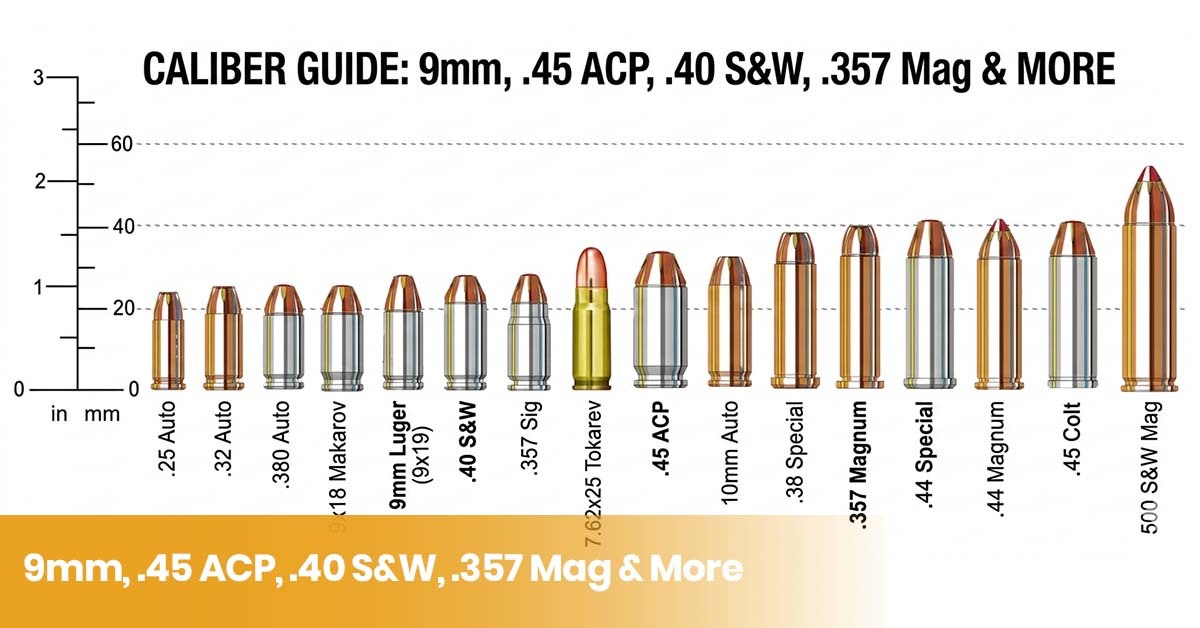
9mm Luger, The Dominant Standard
The 9mm is the most popular handgun caliber in the world, and for good reason. Modern 9mm ammunition, particularly hollow-point defensive loads from brands like Federal HST, Speer Gold Dot, and Hornady Critical Defense, has closed the terminal performance gap with larger calibers significantly.
9mm offers lower recoil, higher magazine capacity, and lower ammunition cost compared to .40 S&W and .45 ACP. For most shooters, especially newer ones, 9mm allows faster follow-up shots and better accuracy. The FBI adopted 9mm after years of using .40 S&W, citing better performance with modern ammunition and less felt recoil.
Best for: Almost everyone. Home defense, carry, range training. It is genuinely hard to go wrong with 9mm in 2026.
.45 ACP, The Old Warrior
The .45 ACP has been a symbol of American shooting culture since 1911. It fires a large, heavy bullet at moderate velocity. Some shooters swear by its “stopping power” and the confidence that comes from a big-bore cartridge.
The trade-offs are real: lower magazine capacity (typically 8–10 rounds in standard-size pistols), higher recoil, and more expensive ammunition. Modern .45 ACP hollow points are highly effective, but they do not meaningfully outperform quality 9mm loads in controlled tests.
Best for: Shooters with a preference for the 1911 platform, experienced pistol shooters comfortable with the recoil, and anyone specifically attracted to the .45 ACP’s history and culture.
See our ranked list of the Best .45 ACP Handguns in 2026.
.40 S&W, The Fading Middle
Developed in the early 1990s as a compromise between 9mm capacity and .45 ACP power, the .40 S&W was once the law enforcement standard. Today it is declining in popularity as modern 9mm loads have matched its performance. Recoil is snappier than 9mm, and ammunition is more expensive. Guns chambered in .40 are still excellent, and used pistols can be found at good prices, but for new buyers, 9mm is the stronger choice.
.357 Magnum, The Revolver Round
For revolver shooters, the .357 Magnum is a compelling choice. It delivers serious power from a medium-frame revolver, and guns chambered in .357 Mag can also fire the milder .38 Special, giving you flexibility. Recoil is substantial, especially from snub-nosed revolvers.
Other Calibers Worth Knowing
- .380 ACP : Common in micro pistols, lighter recoil, reduced stopping power. Good for pocket carry in very small guns.
- .38 Special : Classic revolver round, mild recoil, solid for home defense in a medium-frame revolver.
- 10mm Auto : High-velocity, high-energy round. Popular in hunting and woods carry scenarios. Significant recoil.
Chapter 4 : Semi-Auto vs Revolver: Honest Pros and Cons
This is one of the most common debates in the handgun world. Both action types have genuine strengths, and the right choice depends on the shooter’s needs, experience level, and intended use.
We’ve covered this topic in complete detail in our dedicated guide on Semi-Auto vs Revolver: Which Is Better?.
Semi-Automatic Pistols
Semi-autos dominate the modern handgun market for good reason. They offer higher magazine capacity (typically 15–17 rounds of 9mm in a standard-size pistol), faster reloads, and a wide variety of platform options at every price point. Modern striker-fired semi-autos are extremely reliable when fed quality ammunition and maintained properly.
Advantages: Higher capacity, faster reloads, lighter trigger pulls in many cases, wider variety of configurations, generally easier to add accessories like lights and optics.
Disadvantages: More components and mechanisms means slightly more to learn. Limp-wristing can cause malfunctions in cheaper models. Requires proper grip technique.
Revolvers
Revolvers are mechanically simpler and nearly malfunction-proof in terms of basic operation, if a round fails to fire, you simply pull the trigger again to advance to the next chamber. They are intuitive to operate and there is no need to rack a slide or manage a magazine.
Advantages: Extreme reliability, simple manual of arms, ability to fire specialty ammunition without feeding issues, classic appeal and ease of use for new shooters.
Disadvantages: Lower capacity (typically 5–6 rounds), slower reloads even with a speedloader, generally larger and heavier than semi-autos of comparable caliber, trigger pull is longer and heavier in double-action mode.
For most first-time buyers in 2026, a semi-automatic pistol in 9mm is the practical recommendation. Revolvers remain excellent choices for specific scenarios, particularly home defense where simplicity and reliability are the top priority.
Chapter 5 : Frame Size: Full Size vs Compact vs Subcompact
Once you have chosen your caliber and action type, frame size is the next major variable. Size affects how the gun carries, how it shoots, and how much ammunition it holds.
For a detailed breakdown with specific model comparisons, see our guide on Full Size vs Compact vs Subcompact Handguns.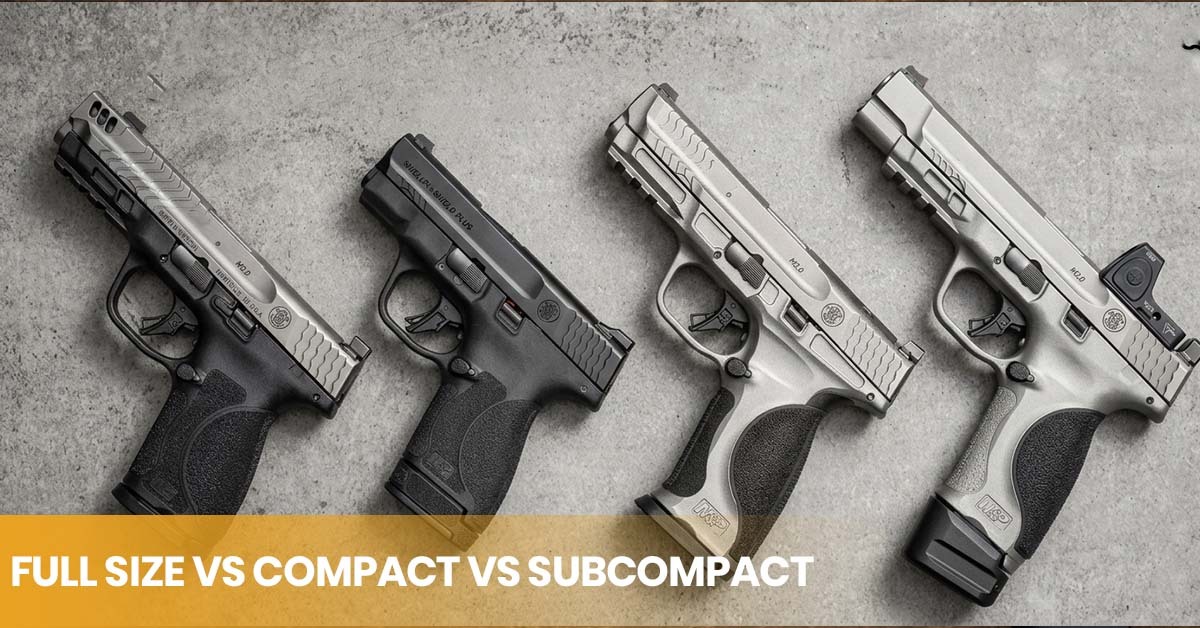
Full-Size Handguns
Full-size pistols have the longest barrels (typically 4.5″ to 5″), the tallest grips (which allow a full four-finger grip for most shooters), and the highest capacity. They are the easiest to shoot accurately because the longer sight radius gives you more precision, and the additional weight absorbs recoil.
The Glock 17, Beretta 92FS, and Sig Sauer P320 Full-Size are classic examples. These guns are ideal for home defense, range work, and competition. They are not ideal for concealed carry unless you are a larger individual with experience in carry techniques.
Compact Handguns
Compact pistols offer a middle ground between shootability and concealability. A compact typically has a barrel length of 3.7″ to 4.1″ and a grip that accommodates three to four fingers. Capacity is typically 10–15 rounds of 9mm.
The Glock 19 is the benchmark compact pistol, and one of the most popular handguns ever made. It is small enough to carry concealed with the right holster and clothing, and capable enough to serve as a home defense or range gun.
If you are torn between full-size and compact, our in-depth comparison covers the Glock 17 vs Glock 19: Which Should You Buy?.
Subcompact Handguns
Subcompacts prioritize concealability above all else. Barrels are typically under 3.5″, and grips often accommodate only two fingers for smaller-handed shooters. Capacity is lower, recoil is snappier, and accuracy at distance is more challenging due to the shorter sight radius.
Popular examples include the Glock 43, Sig P365, and Springfield Hellcat. The Sig P365 was a revolution in the subcompact market when it launched it packed 10+1 rounds of 9mm into a truly pocket-sized frame.
See our detailed take on one of the top subcompacts with the Springfield Armory Hellcat Review 2026.
The Magazine Stack Question
Within each size category, you will encounter single-stack and double-stack magazine options. Single-stack magazines are thinner and may be easier to conceal, while double-stack magazines hold more rounds in a wider grip.
Understand the trade-offs in our guide on Single Stack vs Double Stack Magazines Explained.
Chapter 6 : Budget Breakdown: What $300, $500, $800 Buys You
The handgun market in 2026 is genuinely excellent at every price tier. You do not need to spend $800 to get a reliable, accurate pistol. But spending more does buy you refinement, better materials, improved ergonomics, and in some cases, significantly better out-of-the-box performance.
The $300–$400 Range: Reliable and Functional
At this price point, you will find proven, functional handguns that will protect your home or serve for casual range use. Brands like Taurus, SCCY, Mossberg, and Canik offer legitimate options in this range. The Canik TP9SF and TP9SA have received consistently positive reviews for their value-to-performance ratio.
Trade-offs at this price point include less refined fit and finish, triggers that may benefit from tuning, and fewer aftermarket support options. For a home defense gun that lives in a drawer 365 days a year and is tested occasionally at the range, $300–$400 buys everything you need.
Check out the top picks in our guide to the Best Handguns Under $400 in 2026.
The $500–$700 Range: The Sweet Spot
This is where the handgun market delivers the best combination of value and performance. Glock, Smith & Wesson M&P, Walther, Springfield Armory, and Ruger all offer excellent options in this range.
A Gen 5 Glock 19 retails around $550–$600. A Smith & Wesson M&P 2.0 Compact comes in around the same price. Both offer proven reliability, excellent ergonomics, and massive aftermarket support for upgrades.
Two of the most popular options in this range are compared in detail in our guide on Smith & Wesson M&P vs Glock: Which Wins?.
For home defense specifically, see our curated list of the Best Handguns for Home Defense Under $600.
The $700–$1,000+ Range: Premium Performance
At this level, you are paying for superior materials, tighter tolerances, refined factory triggers, and often optics-ready configurations straight from the factory. Sig Sauer P320 variants, HK VP9, Walther PDP, and CZ pistols occupy this space.
One of the standout options in this category is covered in our Walther PDP Review 2026: Worth the Price?.
For 1911 enthusiasts, this budget range also opens up quality options from Springfield Armory, Dan Wesson, and Kimber, though truly premium 1911s can push well past $1,500.
Chapter 7 : Top Handgun Brands in 2026: Glock, Sig, S&W, Beretta & More
Brand loyalty runs deep in the firearms world. But the best brand is the one that makes the right gun for your specific needs, maintained with quality parts, backed by solid customer service. Here is an honest look at the major players in 2026.
Glock
No brand has shaped the modern handgun market more than Glock. Introduced to American law enforcement in the 1980s, Glock’s polymer-frame, striker-fired pistols became synonymous with reliability and simplicity. The Glock 19 remains arguably the most popular handgun in the United States.
Glock’s advantages include a massive aftermarket ecosystem, extreme parts availability, consistent trigger across the lineup, and a proven track record across decades of service in law enforcement and military use worldwide. If you are a new buyer and cannot decide, a Glock is almost never the wrong choice.
For a broader look at polymer frame options alongside Glock, see our guide on the Best Polymer Frame Handguns 2026.
Sig Sauer
Sig Sauer has had one of the most impressive runs of any firearms company in the past decade. The P365 redefined what a subcompact carry pistol could be. The P320 won the U.S. Army’s modular handgun competition. The P226 has been trusted by Navy SEALs and European militaries for decades.
Sig pistols are known for excellent ergonomics, premium build quality, and innovation. They tend to cost more than comparable Glock products, but many shooters find the trigger feel and overall refinement worth the premium.
Smith & Wesson
Smith & Wesson is one of America’s oldest and most storied firearms manufacturers. Their M&P (Military & Police) line of polymer-frame pistols has become a legitimate competitor to Glock, particularly with the M&P 2.0 updates that improved the trigger and grip texture significantly.
S&W also produces the Shield series of subcompact carry pistols and continues to manufacture classic revolvers like the Model 686 in .357 Magnum. For buyers who want American-made options, S&W is a strong contender.
For a curated list of domestically manufactured options, read our guide on the Best Handguns Made in the USA 2026.
Beretta
The Beretta 92FS is one of the most recognizable handguns in the world, having served as the U.S. military’s M9 service pistol for decades. Beretta pistols are known for exceptional build quality, smooth actions, and longevity. The 92FS in particular has a devoted following for its open-slide design, which contributes to reliability and easy clearing of malfunctions.
We break down whether the 92FS still holds up in our Beretta 92FS Review 2026: Military Classic.
CZ
Czech firearms manufacturer CZ produces some of the finest handguns in the world, with the CZ 75 being a legendary design that has influenced pistol design globally. CZ pistols are known for excellent ergonomics, exceptional triggers, particularly in their Shadow 2 competition variants, and outstanding build quality.
See if the CZ 75 earns its legendary status in our CZ 75 Review 2026: Classic Still Worth It?.
Springfield Armory, Ruger, Walther
Springfield Armory offers strong value at mid-range prices, with the Hellcat and Echelon performing well in competitive reviews. Ruger produces reliable, American-made options like the Ruger Security-9 that punch well above their price point. Walther has re-emerged as a premium contender with the PDP series, which is winning over competitive shooters across the country.
Chapter 8 : Key Features to Look For (Sights, Triggers, Safeties, Grips)
Once you have narrowed your options by purpose, caliber, action type, and brand, these features will help you make the final call between specific models.
Sights
The factory sights on most production pistols are functional but rarely exceptional. Understanding your sight options is important, especially for a carry or defensive pistol.
- Three-dot sights: The most common factory configuration. One dot on the front sight, two dots on the rear. Simple, intuitive, works well in good lighting.
- Night sights (tritium): Contain small tritium inserts that glow green in low-light conditions without requiring batteries or activation. Highly recommended for home defense and carry guns.
- Fiber optic sights: Capture ambient light for a bright, easy-to-acquire front sight. Popular for competition in daylight conditions.
- Red dot optics: Mounted on an optics-ready slide, red dots offer a single point of aim that many shooters find faster and more accurate, especially at distance. Gaining popularity for carry use.
We compare both options in depth in our guide on Night Sights vs Red Dot: Which Is Better for Carry?.
Trigger Pull Weight and Feel
Trigger pull weight, measured in pounds, describes how much force is required to fire the pistol. A lighter trigger is generally easier to shoot accurately because it requires less effort and introduces less movement. However, very light triggers on carry guns raise safety concerns.
Most striker-fired pistols have a pull weight between 5 and 6.5 pounds from the factory. Single-action triggers (1911-style) can be much lighter. DA/SA pistols have a long, heavy first pull in double-action mode, then a shorter, lighter pull in single-action for subsequent shots.
Get the full breakdown on triggers in our guide on What Is Trigger Pull Weight? Beginner Explanation.
If you encounter DA/SA terminology, see our straightforward guide on What Is DA/SA Trigger? Complete Explanation.
Safeties
Manual safeties are a point of debate. Glock pistols have no external manual safety, they rely on trigger, firing pin, and drop safeties built into the mechanism. Many shooters prefer this for defensive use, arguing that a manual safety adds a step that could cost critical seconds under stress.
Others prefer a manual safety, particularly for carry, to add a layer of security against accidental discharge. Smith & Wesson M&P pistols are available in safety and non-safety configurations.
For new shooters, a manual safety can be a confidence builder, but you must train consistently with it so that disengaging becomes muscle memory.
Grip Texture and Ergonomics
A handgun that fits your hand well is safer and easier to shoot. Many modern pistols come with interchangeable backstraps to adjust the grip circumference. Grip texture ranges from subtle to extremely aggressive, aggressive textures help control the pistol under recoil but can be uncomfortable during extended carry against bare skin.
Before buying any pistol, hold it. If possible, shoot it. A gun that feels awkward in your hand will always feel awkward. The right gun should feel natural when you raise it to a firing position.
Handgun Reliability
Reliability is non-negotiable in a defensive handgun. Certain platforms have better track records than others.
Learn what tests to apply and which platforms stand out in our guide on Handgun Reliability Test: What to Look For.
Chapter 9 : How to Buy a Handgun Online: FFL Transfer Explained
Buying a handgun online can save you money and give you access to a much wider selection than any local gun store. The process is legal, straightforward, and commonly misunderstood.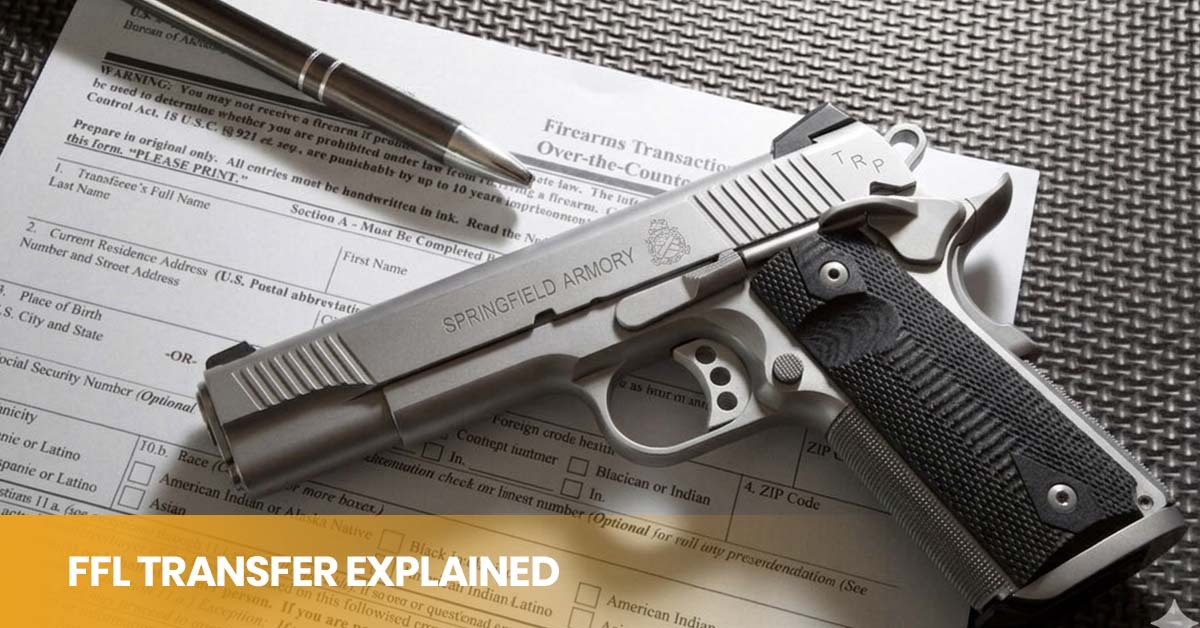
The Legal Framework
Federal law requires that all handgun transfers, including online purchases, go through a federally licensed firearms dealer (FFL). This means you cannot simply purchase a handgun online and have it shipped to your house. It must be shipped to a licensed dealer in your state, who then performs the required paperwork and background check.
Step-by-Step: How an Online Handgun Purchase Works
- Find and purchase the handgun from a licensed online retailer (Shopgoldenbrothers.com, Guns.com, Brownells, etc.).
- Identify a local FFL dealer who will accept the transfer. Many gun stores do this; transfer fees typically range from $20 to $50.
- Provide the online retailer with your FFL dealer’s license information (usually a copy of their FFL). The retailer ships the firearm to the dealer — not to you.
- When the firearm arrives at the FFL, you go to the dealer with a valid government-issued photo ID.
- Complete ATF Form 4473 (the federal firearms transaction record).
- The dealer runs a NICS (National Instant Criminal Background Check System) check. Upon approval, you take possession of your handgun.
State-Specific Considerations
Some states have additional requirements beyond the federal minimum, waiting periods, handgun rosters, permit requirements, or magazine capacity restrictions. Always check your state’s laws before purchasing. California, New York, New Jersey, Massachusetts, and Maryland have notably more restrictive requirements than most states.
Buying online is legal in all states that allow handgun ownership, but the process and timeline vary. In California, for example, there is a mandatory 10-day waiting period after the background check before you can take possession of a firearm.
Chapter 10 : Handgun Safety: Rules Every Owner Must Follow
Firearm safety is not a suggestion, it is a set of non-negotiable rules that prevent accidents and save lives. Every responsible gun owner, from first-time buyers to experienced professionals, follows these rules every single time they handle a firearm.
For a comprehensive breakdown of each rule with context, see our dedicated guide on Handgun Safety Rules Every Gun Owner Must Know.
The Four Universal Rules of Firearm Safety
Rule 1 — Treat every firearm as if it is loaded.
This is the foundational rule. Even if you have just unloaded the gun and visually verified an empty chamber, you treat it as if it could fire at any moment. This mindset prevents every category of negligent discharge.
Rule 2 — Never point the muzzle at anything you are not willing to destroy.
The muzzle is always pointing somewhere. Be intentional about where. Keep the gun pointed in a safe direction, toward the ground, downrange at a range, or in a direction where an accidental discharge would cause the least harm.
Rule 3 — Keep your finger off the trigger until your sights are on the target and you have made the decision to shoot.
More negligent discharges happen from finger-on-trigger than from any other single cause. Your trigger finger lives along the frame, outside the trigger guard, until you are ready to fire. Every time.
Rule 4 — Know your target and what is beyond it.
Bullets travel. A bullet that misses its target, or passes through it, continues downrange. You are responsible for every round you fire.
Safe Storage
Proper storage of a handgun is a legal and moral responsibility. Unsecured firearms in homes with children are a leading cause of preventable gun deaths. Options include quick-access biometric safes for bedside firearms, full-size gun safes for long-term storage, and trigger locks or cable locks as supplementary security measures.
The National Shooting Sports Foundation’s Project ChildSafe program provides free firearm safety kits, including cable locks, through law enforcement agencies across the country.
Cleaning and Maintenance Safety
Before cleaning any handgun, remove the magazine and lock the slide back to verify the chamber is empty. Visually and physically confirm the chamber is empty. Then confirm it again. Negligent discharges during cleaning are preventable with this simple protocol.
For a proper cleaning walkthrough, see our guide on How to Clean a Handgun Step by Step.
Chapter 11 : Your First Range Day: What to Expect
There is a significant gap between handling a handgun at a store counter and actually shooting one at a range. Your first range day will be educational, possibly humbling, and, if you approach it with the right mindset, a lot of fun.
What to Bring
- Your handgun (unloaded, in a case)
- Ammunition, at least 100 rounds for a productive session
- Eye protection (safety glasses, not sunglasses)
- Ear protection (foam earplugs at minimum; electronic earmuffs are far superior)
- A cleaning kit for after the session
- A notebook, seriously, take notes on what worked and what did not
Range Rules and Etiquette
Every range has its own rules, but universal etiquette includes: always treat your firearm as loaded, keep the muzzle downrange at all times, wait for a cold range signal before going downrange to check or change targets, and never handle a firearm when others are downrange.
If you are new and unsure of anything, ask the range safety officer. They are there to help. No good range RSO will make you feel bad for asking questions.
Your First Session Goals
Do not try to do too much in your first session. Pick three things to focus on: a solid grip, front sight focus, and a smooth trigger press. Accuracy at distance comes later. Many instructors recommend new shooters start at 7 yards and focus on fundamentals before moving targets farther out.
Expect to be surprised by felt recoil, it is usually less than you anticipated for 9mm. Expect your first groups to be less precise than you hoped. That is normal. Shooting is a skill, and skills are built through practice.
After the Range
After shooting, clean your handgun at home. Fouling from powder residue and bullet materials builds up quickly. A clean, lubricated pistol runs more reliably and lasts longer. Make cleaning a non-negotiable part of every range session.
Once you are comfortable at the range, the next step for carry shooters is finding a reliable holster. See our guide on the Best Handgun Holsters for Everyday Carry 2026.
For shooters who fall in love with precision shooting at the range, check out our guide on the Best Handguns for Target Shooting 2026.
Chapter 12 : FAQs: The 10 Questions We Hear Every Single Week
1. What is the best handgun for a first-time buyer?
For most first-time buyers, a Glock 19, Smith & Wesson M&P 2.0 Compact, or Sig Sauer P320 Compact in 9mm is the recommendation. All three are reliable, widely supported, beginner-friendly, and versatile enough to serve for home defense, carry, and range use.
2. How much should I spend on my first handgun?
Budget between $450 and $650 for your first handgun. Below that range, quality drops noticeably. Above that range, the additional cost buys refinements that matter more to experienced shooters than beginners. Do not forget to budget for ammunition, a holster, eye/ear protection, and a cleaning kit.
3. Is 9mm good enough for self-defense?
Yes. Modern 9mm hollow-point ammunition from reputable manufacturers is demonstrably effective for personal defense. The FBI, most law enforcement agencies, and the vast majority of self-defense instructors recommend quality 9mm defensive loads for personal protection.
4. Do I need a permit to buy a handgun?
It depends on your state. Federally, you must pass a NICS background check. Some states require a purchase permit, Firearm Owner’s Identification Card (FOID), or handgun safety certificate before you can buy. Research your specific state’s requirements before purchasing.
5. How long does a handgun last?
A quality handgun maintained properly can last tens of thousands of rounds and many decades. Barrels and recoil springs are wear items that need eventual replacement, but the frame and slide of a well-made pistol are essentially indefinite in service life with proper care.
Get the detailed answer in our guide on How Long Does a Handgun Last? Lifespan Guide.
6. What is the best handgun for left-handed shooters?
Ambidextrous controls are increasingly standard on modern pistols. The Walther PDP, CZ P-10, and Sig P320 all offer fully ambidextrous magazine releases and slide releases. Left-handed shooters should prioritize ambidextrous controls when shopping.
See our curated list of the Best Handguns for Left-Handed Shooters.
7. Should I get a safety on my first handgun?
This is a personal decision. If you are confident in following the four safety rules consistently, a manual safety is not necessary — and some argue it adds a step that could fail under stress. If a manual safety gives you confidence as a new owner, choose a model with one and train to use it consistently.
8. How often should I clean my handgun?
After every range session and every month of carry, at minimum. A defensive carry gun should be cleaned monthly even if not fired, as lint and debris accumulate. After range sessions, clean and lubricate before the gun goes back into service or storage.
9. Can I use the same handgun for carry and home defense?
Yes, this is one of the most practical approaches. A compact pistol in 9mm serves both roles well. You train with the same gun, develop deep familiarity with one trigger, and simplify your ammunition logistics.
10. What accessories do I actually need?
For starters: quality ammunition, at least two spare magazines, a quality holster if carrying, eye and ear protection for the range, and a basic cleaning kit. Night sights or a weapon light for a home defense gun are strong additions. Everything else, optics, aftermarket triggers, grip tape, comes later when you know what you actually need.
Final Words: Buy Smart, Train Hard, Stay Safe
The handgun market in 2026 has never been better. Quality is up across every price tier, reliability is exceptional from the major manufacturers, and the information available to buyers has never been more accessible.
Your job as a buyer is to cut through the noise, the forum debates, the brand loyalism, the marketing, and make a decision based on your actual needs, your actual budget, and your honest self-assessment as a shooter.
Buy a quality gun that fits the job you need it to do. Train with it seriously. Store it safely. And use every guide in this cluster to keep learning.
You are making a responsible, informed choice. That is exactly the kind of gun owner the shooting community needs more of.