
What “Frame Size” Actually Means
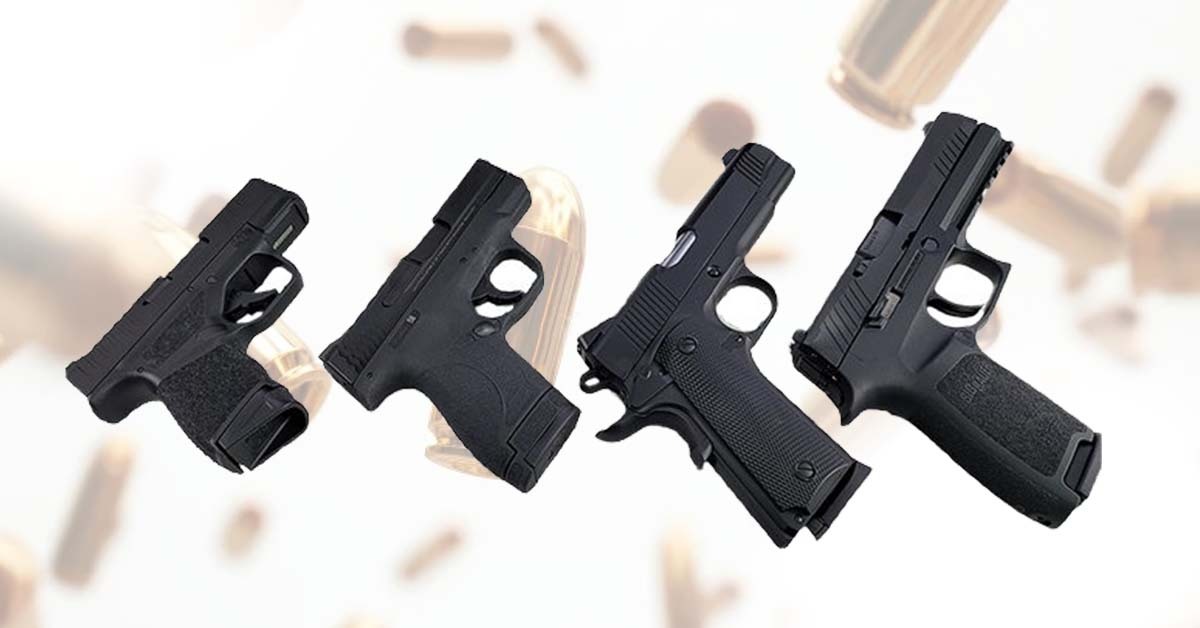
When manufacturers or gun stores talk about “frame size,” they are describing the overall physical footprint of the pistol. That footprint directly affects three things:
Barrel length : Longer barrels generally mean better accuracy and higher muzzle velocity.
Grip length : Determines how many fingers wrap the gun naturally, which affects control and capacity.
Overall height and width : Dictates whether the gun conceals under clothing and how it rides in a holster.
These are not arbitrary categories. They represent genuine trade-offs between shootability, capacity, portability, and concealability. Understanding each category helps you match the gun to the job.
Full-Size Handguns: Maximum Performance, Minimum Compromise
What Makes a Pistol “Full Size”?
Full-size pistols are the big dogs of the handgun world. They are built for performance first, portability second. When you pick one up, you feel the difference immediately, a solid, planted grip, a longer sight radius, and a weight that settles into your hand.
Here are the general specifications you can expect from a full-size handgun:
| Specification | Typical Full-Size Range |
|---|---|
| Barrel Length | 4.5″ – 5.5″ |
| Overall Length | 7.5″ – 9.0″ |
| Overall Height | 5.2″ – 5.8″ |
| Weight (unloaded) | 28 – 40 oz |
| Magazine Capacity (9mm) | 15 – 21 rounds |
Why Full-Size Guns Shoot Better
The physics are simple. A longer barrel gives the bullet more time to accelerate, producing slightly higher muzzle velocity. The longer sight radius, the distance between your front and rear sights, amplifies small aiming improvements and makes target acquisition easier at distance.
The extra weight also works in your favor. More mass absorbs recoil instead of transmitting it to your hands. Back-to-back shots feel flatter and more controlled. Your split times between shots improve. If you are serious about precision or competition, a full-size platform gives you a built-in mechanical advantage.
Best Uses for Full-Size Handguns
Home Defense: This is where a full-size pistol absolutely shines. Stored in a quick-access bedside safe, a full-size gun with a weapon light mounted to the rail gives you maximum capacity, maximum control, and maximum stopping capability. You are not worried about printing. You are not worried about weight on your hip. You just need reliable performance in a high-stress situation. A full-size delivers.
Range and Target Shooting: Extended range sessions are simply more enjoyable with a full-size pistol. Less fatigue, better accuracy, smoother trigger feel. If you shoot twice a month or more, a full-size is where you build the fundamentals that transfer to every other platform.
Competition: Virtually every competitive shooting discipline has a full-size pistol dominating the winner’s circle. Whether it is USPSA, IDPA, or 3-Gun, the full-size platform gives competitors the grip, the sight radius, and the capacity that drives winning performance.
Duty and Open Carry: Law enforcement officers carry full-size pistols for a reason. When concealment is not the priority and performance is, full-size wins. In states with open carry laws, many civilian shooters choose full-size handguns for exactly the same reason.
Popular Full-Size Models Worth Knowing
The Glock 17 is the benchmark. Introduced in 1982, it set the standard for polymer-frame striker-fired pistols and remains one of the most reliable handguns ever manufactured. 17+1 capacity, proven trigger, massive aftermarket support.
The Beretta M9 (92FS) is a legend of American military service. The open-slide design contributes to exceptional reliability and easy malfunction clearing. It is a DA/SA platform, which means the first trigger pull is longer and heavier than subsequent shots something to practice with, but not a dealbreaker.
If you want to browse full-size handguns available right now, explore the complete handgun inventory at Golden Brothers Co, including full-size options from Beretta, Auto-Ordnance, and more.
The One Drawback of Full-Size
Concealed carry is genuinely difficult with a full-size pistol unless you are a larger individual with experience in dedicated carry techniques and proper holster selection. The grip length is the primary culprit, it extends below the hip bone during IWB carry and creates printing that is hard to manage under normal clothing.
Some very experienced carriers do run full-size guns daily. But for most people, a full-size pistol lives at home, at the range, or on the nightstand not on their hip at the grocery store.
Compact Handguns: The Sweet Spot Most Buyers Land On
What Makes a Pistol “Compact”?
Compact pistols occupy the middle ground between full-size performance and subcompact concealability. They were not an afterthought or a compromise, they were engineered specifically to serve both roles reasonably well without failing catastrophically at either.
| Specification | Typical Compact Range |
|---|---|
| Barrel Length | 3.7″ – 4.2″ |
| Overall Length | 6.5″ – 7.5″ |
| Overall Height | 4.8″ – 5.2″ |
| Weight (unloaded) | 22 – 30 oz |
| Magazine Capacity (9mm) | 10 – 15 rounds |
Why Compacts Have Become the Default Choice
Ask any firearms instructor what they recommend for a first-time buyer who wants one gun for everything, home defense, carry, and range work, and the answer is almost universally a compact pistol. The Glock 19 has been called the most recommended handgun in America for this exact reason.
Here is what makes compacts special:
The barrel is short enough to tuck under a cover garment during inside-the-waistband carry, but long enough that you are not giving up meaningful accuracy or velocity at defensive distances. The grip accommodates most shooters’ full hand, three fingers plus the pinky, comfortably, which gives you control without the bulk of a full-size.
Capacity in the 10 to 15-round range covers home defense and carry needs without the weight penalty of a full-size magazine.
And with many compact platforms, including the Glock 19, you can run full-size magazines for range shooting and swap to a flush-fit compact magazine for carry. One gun, two roles, zero compromise.
Best Uses for Compact Handguns
Concealed Carry: An experienced carrier with a good holster and appropriate clothing can conceal a compact pistol effectively in most situations. It requires more deliberate clothing choices than a subcompact, but most daily carry practitioners find the size-performance trade-off well worth it.
Home Defense: A compact with a weapon light on the rail covers home defense duties cleanly. Slightly less capacity than a full-size, but more than enough for any realistic defensive scenario.
Range Training: The compact platform is capable enough for serious accuracy work. It is not a dedicated competition gun, but it can teach you fundamentals, build trigger discipline, and produce respectable groups at 25 yards in the right hands.
Travel with a Firearm: Compact pistols fit more cleanly into travel cases, portable safes, and vehicle holsters. If your gun travels with you, a compact makes logistics easier.
Popular Compact Models Worth Knowing
The Glock 19 needs no introduction. Arguably the most popular handgun in America, period. 15+1 capacity, proven reliability, and an ecosystem of aftermarket parts and accessories so deep that it is borderline overwhelming. This is the benchmark compact.
The Sig Sauer P320 Compact is the civilian variant of the U.S. Army’s M17 service pistol. The modular chassis design means you can swap grip modules, calibers, and barrel lengths, truly one of the most versatile compact platforms on the market.
The Smith & Wesson M&P 2.0 Compact in 9mm has won over a massive following with its improved trigger over the original M&P, excellent grip texture, and American-made reliability.
Ready to find your compact pistol? Shop handguns at Golden Brothers Co and filter by the caliber and capacity that fit your needs. The team in Thomasville can also help you find your fit in person.
Subcompact Handguns: Carry-First, Everything Else Second
What Makes a Pistol “Subcompact”?
Subcompact pistols are engineered around a single priority: making the gun as small as possible while retaining functional reliability and meaningful capacity. Everything else, shootability, recoil management, grip comfort at extended sessions, is secondary.
| Specification | Typical Subcompact Range |
|---|---|
| Barrel Length | 2.9″ – 3.6″ |
| Overall Length | 5.5″ – 6.5″ |
| Overall Height | 4.0″ – 4.8″ |
| Weight (unloaded) | 14 – 24 oz |
| Magazine Capacity (9mm) | 6 – 13 rounds |
The Physics of Going Small
When you shrink a pistol, you change the shooting experience in ways that matter. Shorter barrels mean slightly reduced muzzle velocity. Shorter sight radius makes precise aiming at distance harder. Lighter weight means more felt recoil with the same ammunition.
None of this makes subcompacts bad. It means you are making a conscious trade, you accept slightly harder shooting in exchange for a gun that genuinely disappears under your clothes.
The Sig P365 was a watershed moment in subcompact design when it launched, delivering 10+1 rounds of 9mm in a frame barely larger than a single-stack micro pistol. That capacity-to-size ratio changed what buyers expected from the category.
The Reality of Shooting a Subcompact
If you have only ever shot a full-size or compact pistol, your first session with a subcompact will be an adjustment. The snappier recoil impulse and shorter grip require deliberate technique, a firm, high grip, aggressive stance, and controlled trigger press. Shooters who muscle full-size guns through poor technique often develop noticeable accuracy problems when they switch to a subcompact.
This is not a reason to avoid subcompacts. It is a reason to train with one regularly if you carry one. A gun you carry every day should be the gun you train with most.
Best Uses for Subcompact Handguns
Everyday Concealed Carry (EDC): This is what subcompacts were born for. When your lifestyle, clothing, or environment demands serious discretion, a subcompact goes where a compact cannot. Summer carry in a t-shirt, pocket carry in appropriate holsters, appendix carry under a slim dress shirt, the subcompact makes it all work.
Backup Firearm: Experienced carriers and law enforcement professionals sometimes carry a subcompact as a backup to a primary full-size or compact. A subcompact ankle holster or pocket carry piece gives you a redundant option.
Deep Concealment: Specific situations, formal attire, plain-clothes professional environments, travel, demand the absolute minimum profile. A subcompact delivers that without forcing you to go unarmed.
Popular Subcompact Models Worth Knowing
The Sig Sauer P365 is the gold standard of modern subcompacts. 10+1 capacity (with extended magazines up to 17 rounds) in a grip barely wider than a single-stack pistol. Night sights come standard. The X-Ray3 sight system is genuinely excellent. If you are buying your first subcompact, the P365 belongs at the top of your list.
The Glock 43X expanded the original G43’s grip slightly to accommodate a 10-round magazine while remaining genuinely slim and concealable. Glock’s legendary reliability in a carry-optimized package.
The Springfield Armory Hellcat challenged the P365 directly with a 13+1 standard capacity magazine in a subcompact frame. The adaptive grip texture is aggressive enough for hot range sessions and confident carry.
For subcompact handguns and the ammunition to run in them, check what’s available at Golden Brothers Co, including 9mm handgun ammo stocked in the 9mm Luger section to keep your subcompact fed.
Head-to-Head Comparison: Full Size vs Compact vs Subcompact
Here is how the three categories stack up across the factors that actually matter to real buyers:
| Factor | Full Size | Compact | Subcompact |
|---|---|---|---|
| Accuracy at 25 yards | Excellent | Very Good | Good |
| Recoil Management | Best | Good | Harder |
| Concealed Carry | Difficult | Manageable | Best |
| Home Defense | Best | Very Good | Good |
| Magazine Capacity | Highest | Mid-High | Lowest |
| Range Comfort | Best | Good | Tiring |
| Competition Use | Best | Capable | Limited |
| Beginner Friendliness | Highest | High | Moderate |
| Overall Weight | Heaviest | Medium | Lightest |
The Hard Truth About “One Gun for Everything”
Many buyers want a single handgun that carries every day, handles home defense, and gets shot at the range weekly. That is a completely reasonable goal, and a compact pistol satisfies it better than the other two categories.
But be honest with yourself. If you live in a colder climate where layers mean you can comfortably conceal a compact year-round, a compact is ideal. If you live somewhere hot and wear light clothing nine months a year, a subcompact is more realistic for daily carry.
The gun that lives in your safe because it is too hard to carry is not protecting you. The gun you actually carry every day is.
Matching Frame Size to Your Specific Situation
For First-Time Buyers
Start with a compact. The Glock 19, S&W M&P 2.0 Compact, or Sig P320 Compact are all excellent first handguns that you will not outgrow. They are easy enough to learn on, capable enough for serious use, and versatile enough to grow with your skills.
For Experienced Carriers Who Want to Go Smaller
If you have been carrying a compact and want to reduce your profile, the Sig P365 or Springfield Hellcat are the proven transition options. Commit to training time with your new carry gun before trusting it for EDC.
For Home Defense Only
Buy a full-size. You will not regret the extra capacity, the easier shooting, or the improved ability to mount a weapon light. The Beretta M9, a full-size Sig, or a Glock 17 stored in a bedside quick-access safe is about as capable a home defense setup as you can build.
For Competition Shooters
Full-size, always, unless your division rules say otherwise. The mechanical advantages are real and meaningful at the competitive level.
For Someone Who Carries in Business or Formal Settings
Subcompact, pocket holster or AIWB, done. The P365 or Hellcat in a quality appendix holster disappears under a sport coat or dress shirt with minimal printing.
A Word on Ammunition Across Frame Sizes
The caliber you run matters regardless of frame size, but frame size changes how that caliber feels when it fires.
In a full-size 9mm pistol, .40 S&W and even .45 ACP are manageable for most shooters. In a compact, they are still reasonable but noticeably snappier. In a subcompact, .40 S&W and .45 ACP become genuinely punishing for extended sessions.
This is one of the reasons 9mm has become so dominant across all frame sizes. Modern defensive 9mm loads from Federal, Speer, and Hornady have closed the terminal performance gap with larger calibers, and 9mm in a subcompact is still controllable enough for accurate defensive shooting.
For any handgun you buy, stock quality defensive ammunition alongside your range training ammo. Golden Brothers Co carries 9mm Luger, .40 S&W, and .45 ACP handgun ammunition for every frame size in their lineup.
Don’t Forget: Frame Size Is Only Part of the Decision
This guide focuses on frame size, but it lives inside a larger decision-making process. Before you pull the trigger on a purchase, make sure you have thought through:
Caliber : 9mm is the practical choice for most buyers, but the right caliber depends on your intended use.
Action type : striker-fired, DA/SA, or SAO each have implications for how you train and carry.
Budget : frame size affects price, but brand and features matter more.
Your specific use case : carry, home defense, competition, or range. Frame size means different things in each context.
For everything surrounding those decisions, the Complete Handgun Buying Guide from Golden Brothers Co walks you through every major variable before you buy, calibers, action types, brands, budgets, online purchasing, and safety. If you have not read it, that is the logical next step.
Where to Buy Your Next Handgun
Whether you have settled on a full-size pistol for the nightstand, a compact for daily carry, or a subcompact for deep concealment, Golden Brothers Co has a handgun for your needs.
Browse the full handgun inventory here including pistols from Auto-Ordnance, Beretta, and more, with online purchase and FFL transfer options available nationwide. If you are in the Thomasville, Georgia area, stop in at 1710 Smith Avenue and let the team help you find the right fit in person.
And if you need ammunition to go with your purchase, the handgun ammo section carries everything from 9mm Luger to .357 Mag, so you leave with everything you need in one place.
Frequently Asked Questions
Q: Is a compact or subcompact better for a beginner?
For most beginners, a compact is the better starting point. Subcompacts are harder to shoot accurately due to increased felt recoil and shorter grip. A compact like the Glock 19 or M&P 2.0 Compact teaches proper technique without fighting the gun’s size.
Q: Can you conceal a full-size handgun?
Experienced carriers with proper gear and appropriate clothing can conceal full-size pistols. It requires a quality IWB holster, a cover garment, and deliberate dressing habits. For most people, a compact or subcompact is a more practical daily carry choice.
Q: Do subcompacts have less stopping power than full-size guns?
In the same caliber, the difference is marginal at defensive distances. Slightly reduced muzzle velocity from a shorter barrel does not meaningfully change terminal performance with quality hollow-point ammunition. The real variable is caliber and ammunition selection, not frame size.
Q: What is the best compact handgun for 2026?
The Glock 19 remains the benchmark, but the Sig P320 Compact, S&W M&P 2.0 Compact, and Walther PDP Compact are all serious contenders. Best is subjective, the gun that fits your hand, budget, and use case best is the right answer.
Q: Are subcompact pistols reliable?
Yes, modern subcompact pistols from quality manufacturers are highly reliable. Earlier generations of micro pistols had feeding issues with certain ammunition, but current production subcompacts from Sig, Glock, Springfield, and others are thoroughly tested. Feed them quality ammunition and maintain them properly.