
If you’ve spent any real time in the competition shooting world, USPSA, IPSC, 3-Gun, or even just serious range work, you’ve seen the Glock 34 in someone’s holster. And there’s a reason for that.
I’m not going to give you the manufacturer’s press release wrapped in fresh words. This is a real breakdown of the Glock 34, what it does well, where it falls short, who it’s actually built for, and whether it deserves the reputation it’s earned as one of the top competition pistols on the market today.
Let’s get into it.
What Is the Glock 34?
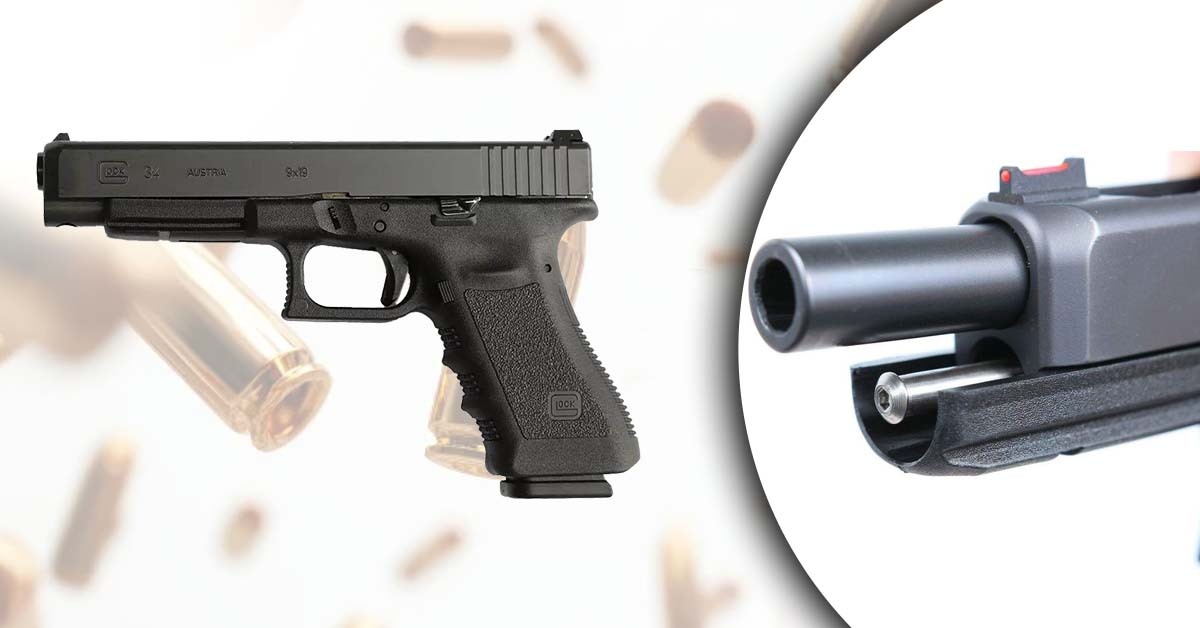
The Glock 34 is Glock’s dedicated “Practical/Tactical” competition pistol, chambered in 9mm. It’s essentially a stretched version of the iconic Glock 17, with a longer barrel and slide, an extended sight radius, and a slightly lighter trigger pull right out of the box.
Glock introduced the G34 specifically for practical shooting sports, it wasn’t an afterthought. That design intent shows in everything from the trigger geometry to the weight distribution.
Quick Specs:
| Feature | Specification |
|---|---|
| Caliber | 9mm Luger |
| Barrel Length | 5.31 inches |
| Overall Length | 8.82 inches |
| Height | 5.47 inches |
| Width | 1.34 inches |
| Weight (Unloaded) | 22.97 oz |
| Magazine Capacity | 17+1 (standard) |
| Trigger Pull | ~5.5 lbs |
| Action | Safe Action (striker-fired) |
| Frame | Gen 5 (current production) |
First Impressions Out of the Box
The Glock 34 Gen 5 ships in Glock’s standard blue plastic case with two magazines (17-round), a cleaning rod, a brush, and a magazine loader. Nothing surprising there.
Pick it up and the balance immediately feels different from a Glock 19 or even a 17. The weight sits slightly forward, a product of that extended barrel and that’s not a bad thing. For competition shooting, a slight forward balance helps manage muzzle rise. You notice it after the first few strings of fire.
The grip texture on the Gen 5 is aggressive enough to be functional but won’t shred your hands during a 200-round practice session. The beaver tail is a nice touch that Gen 4 and earlier buyers had to add aftermarket.
One thing that stands out immediately: the factory trigger. The Glock 34 ships with Glock’s competition connector, which gives a slightly lighter, crisper break than a standard Glock trigger. It’s not a match-grade trigger straight out of the box, but it’s noticeably better than what you get on a stock Glock 19.
Performance at the Range
This is where the Glock 34 starts to separate itself from the pack.
Accuracy
The extended 5.31-inch barrel and longer sight radius make a measurable difference in accuracy at distance. On a standard USPSA target at 25 yards, a competent shooter can consistently hit A-zones with the factory sights. The longer sight radius gives you more precise front/rear sight alignment, and that compounds over dozens of draw-and-fire repetitions.
Is it inherently more accurate than a Glock 17? Mechanically, not dramatically. The barrel lockup is similar. But the sight radius advantage is real and consistent.
Recoil and Muzzle Control
This is the Glock 34’s strongest selling point for competition use. The longer, heavier slide dampens felt recoil slightly compared to the G17, and that forward weight balance keeps muzzle flip more controlled. Fast splits, shooting two rounds in rapid succession, feel more controllable, and getting back on target for a follow-up shot is noticeably quicker.
Running standard 115gr 9mm through it, muzzle rise is minimal. For competitors who push their splits, this translates directly into better stage times.
Speaking of ammunition, the 9mm Luger is the natural pairing here, and having a reliable supply of quality 9mm Luger ammo matters more than most people realize when you’re running high round counts in practice. Cheap or inconsistent ammo introduces variables you don’t want when you’re trying to tune your splits and transitions.
Trigger Feel
Factory, the Glock 34 Gen 5 trigger breaks at around 5.5 lbs. It’s smoother than earlier generations, with less pre-travel mushiness. The reset is short and tactile.
For Production division shooters who have to run near-stock triggers, this is a significant advantage. For Limited or Open shooters who are going full aftermarket anyway, the factory trigger is just a starting point.
Glock 34 vs Glock 17: What’s Actually Different?
This is the question I get asked most often. Here’s the honest comparison:
Barrel length: The G34 adds 0.51 inches over the G17. That doesn’t sound like much, but in practical shooting terms, it adds meaningful sight radius and a small velocity boost.
Slide weight: Slightly heavier on the G34, which softens the recoil impulse modestly.
Trigger: The G34 ships with Glock’s competition connector. The G17 does not.
Size: The G34 is larger and doesn’t conceal well. That’s not its job. The G17 is a better all-around pistol if you want one gun for everything.
For competition: The G34 wins, and it’s not close. For everything else, the G17 holds its own.
Glock 34 for USPSA and IPSC: Real-World Evaluation
In USPSA Production division, the Glock 34 is arguably the dominant platform. It fits within the box requirements, meets all rulebook specs, and the factory trigger, combined with an allowable aftermarket connector, gives shooters a competitive trigger without violating Production rules.
Transitions between targets are smooth. The slightly longer grip frame (same as the G17) gives you a full hand grip that’s natural and consistent. Magazine changes are fast because the grip is substantial enough to find quickly under pressure.
The one place USPSA competitors note a disadvantage is weight. For Open or Limited shooters, the G34 lacks the mass of a 2011 or a fully-built competition pistol. Recoil management in those higher-weight classes is noticeably easier with heavier platforms.
For Production and Carry Optics, the Glock 34 is a genuine top-tier choice.
Common Upgrades and Modifications
The Glock 34 has a massive aftermarket ecosystem. Here’s what most competition shooters actually run:
Sights: The factory polymer sights need to go, full stop. Most competitors run fiber optic front/blacked-out rear for fast target acquisition. Dawson Precision and Trijicon make popular options.
Trigger: A lighter connector (3.5 lb) and polished components drop the trigger pull and improve reset feel. Within Production rules, this is legal territory.
Magazine extensions: Glock 17 magazines drop free naturally. Many competitors run 20+ round extended magazines for stages that allow it.
Magwell: A competition magwell makes reloads faster and more consistent under pressure.
Optics: The Gen 5 MOS (Modular Optic System) variant accepts red dot sights directly. For Carry Optics division, this is the way to go.
Who Should Buy the Glock 34?
Be honest with yourself before dropping money on this pistol.
Buy the Glock 34 if:
- You’re actively competing in USPSA, IPSC, or similar practical shooting sports
- You shoot Production or Carry Optics division specifically
- You want a Glock platform with the best out-of-the-box competition features
- You’re willing to invest in quality ammo and training to make the most of the platform
Consider something else if:
- You want a carry gun, the G34 is too long to conceal comfortably
- You want one pistol for everything, the Glock 17 or Glock 19 serves that role better
- You’re a complete beginner, you’ll get more value starting on a Glock 19 and building fundamentals first
For anyone serious about competition, though, the Glock 34 earns its reputation. The combination of factory trigger, sight radius, and recoil management in a proven, reliable platform is genuinely hard to beat in Production division.
If you’re looking to shop competition-ready handguns or stock up on 9mm before your next match, Golden Brothers Co has been serving American shooters since 1909, with licensed FFL transfers nationwide and a curated selection of pistols built for the range.
Glock 34 vs the Competition: How Does It Stack Up?
| Pistol | Barrel | Trigger (Factory) | Best Use |
|---|---|---|---|
| Glock 34 | 5.31″ | ~5.5 lbs | USPSA Production / CO |
| Glock 17 | 4.49″ | ~5.5 lbs | Duty / All-Purpose |
| Glock 19 | 4.02″ | ~5.5 lbs | Carry / Versatility |
| CZ Shadow 2 | 4.89″ | ~4.4 lbs | Competition |
| Sig P320 X5 Legion | 5.00″ | ~3.5 lbs | Competition |
The CZ Shadow 2 and Sig P320 X5 Legion offer better factory triggers. If trigger feel is your top priority and you’re not locked into the Glock ecosystem, those are worth a serious look. But for Glock loyalists, the 34 is the natural competition destination.
Final Verdict
The Glock 34 is exactly what it was designed to be: a purpose-built competition pistol that leverages Glock’s legendary reliability and adds features that matter for practical shooting sports.
It won’t win on trigger feel against a tuned CZ or a full-build 2011. It’s not a carry gun. But for USPSA Production and Carry Optics, it’s among the best options you can run right now, especially when you account for aftermarket support, parts availability, and the trust factor that comes with Glock’s track record.
If you’re stepping up to competitive shooting and want a pistol that works day one and scales as you improve, the Glock 34 belongs on your short list.
Rating: 4.4 / 5
Frequently Asked Questions About the Glock 34
Q: What is the Glock 34 best used for?
The Glock 34 is primarily designed for practical shooting competition, specifically USPSA, IPSC, and IDPA. Its longer barrel, extended sight radius, and competition-tuned trigger make it better suited for the range than everyday carry.
Q: What is the difference between the Glock 34 and Glock 17?
The Glock 34 has a 5.31-inch barrel compared to the Glock 17’s 4.49-inch barrel, giving it a longer sight radius and slightly improved muzzle velocity. It also ships with Glock’s competition connector for a lighter trigger pull. The G17 is more compact and better suited for general use or carry.
Q: Is the Glock 34 legal for USPSA Production division?
Yes. The Glock 34 Gen 5 meets USPSA Production division requirements. It’s one of the most commonly run pistols in that division due to its factory competition features and reliability.
Q: What ammo does the Glock 34 use?
The Glock 34 is chambered in 9mm Luger (also called 9x19mm or 9mm Parabellum). It runs standard 115gr, 124gr, and 147gr loads reliably. For competition use, 124gr or 147gr loads are popular for slightly softer recoil impulse.
Q: Can the Glock 34 be used for concealed carry?
Technically yes, but it’s not practical. At 8.82 inches overall length, the G34 is difficult to conceal comfortably under most clothing. The Glock 17 or Glock 19 are far better options if concealed carry is a priority.
Q: Does the Glock 34 Gen 5 have a MOS (Modular Optic System) version?
Yes. Glock offers the G34 Gen 5 MOS, which comes with a pre-cut slide for red dot optic mounting. This is the recommended version for Carry Optics division competitors.
Q: What magazines does the Glock 34 use?
The Glock 34 uses standard Glock 17 magazines (17-round capacity). Extended magazines (19, 22, and 33-round) are also compatible and widely used in Open division competition.
Q: How reliable is the Glock 34 for high round counts?
Very reliable. Like all Glock pistols, the G34 is built to run through high round counts with minimal maintenance. Competition shooters regularly run tens of thousands of rounds through G34s with standard cleaning and spring replacement intervals.
For more information on safe and responsible firearm ownership, including laws on purchasing handguns, refer to the ATF’s official firearms buyer’s guide at atf.gov.